Ukrainian forces allegedly captured an S-70 drone last October—although Russia may have intentionally crashed it in order to prevent its recovery intact.
Russia’s war machine continues grinding on, producing new systems and developing new technologies to sustain the war effort against Ukraine and to better compete with the Americans. Toward that end, Russia’s S-70 Okhotnik-B unmanned combat aerial vehicle (UCAV) appears poised to become the next big Russian platform.
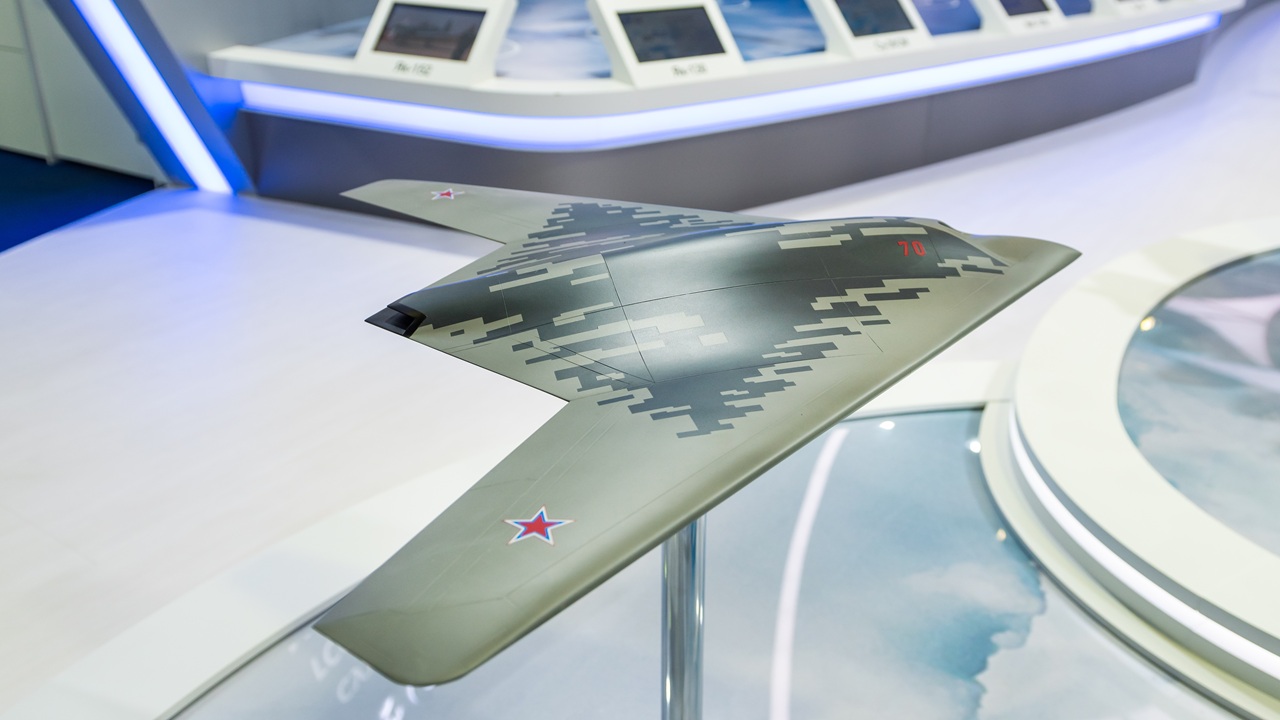
A heavy stealth UCAV being developed by Russian aerospace manufacturer Sukhoi in cooperation with Mikoyan MiG, it is sometimes referred to as the “sixth-generation unmanned aerial vehicle.” The first prototype flew on August 3, 2019, and serial production was slated to begin in the second half of 2024.
Understanding the S-70 Drone
- Year Introduced: 2019 (first flight)
- Number Built: Unknown
- Length: Unknown
- Wingspan: 20 m (65 ft)
- Weight: ~18,144 kg (40,000 lb)
- Engines: One AL-31F or AL-41F turbofan engine (adapted from Su-35/Su-57)
- Top Speed: ~1,000 km/h (621 mph)
- Range: ~6,000 km (3,700 mi)
- Service Ceiling: Unknown
- Loadout: ~2,000 kg (4,400 lb) payload capacity; has internal weapons bay for stealth
- Aircrew: 0
At first glance, the S-70 resembles a slightly smaller version of the B-2 Spirit or B-21 Raider bombers. That is not a coincidence. Like the American stealth planes, the Russian drone has a flying-wing configuration intended for reduced radar cross-section (RCS). One of the principal concepts is for the S-70 to operate in concert with the manned Sukhoi Su-57 fighter jet, acting as a “loyal wingman”—extending sensor coverage, serving as a decoy, carrying additional weapons, and the like.
The initial contract for this heavy UCAV appears to be from around 2011 when the Russian Ministry of Defense (MoD) selected Sukhoi to lead a heavy unmanned reconnaissance/attack drone program. Taxiing tests were done in late 2018 at the Novosibirsk facility. The first full flight of the S-70 occurred in 2019 above Chkalov State Flight Test Center in Akhtubinsk.
A joint flight with Su-57 (to test teaming) was reported in 2019 as well. The S-70 allegedly flew autonomously for about 30 minutes while interacting with an Su-57. Two years thereafter, three additional prototypes were reportedly built with improved avionics and a flat exhaust nozzle for improved stealth and infrared signature.
As of later January 2024, the vice-governor of Russia’s Novosibirsk Oblast said serial production might begin in the second half of 2024. The program has been described as “slow going.” It has faced developmental and operational challenges.
Yet, contrary to what Western media sources believe, the program has continued forward so that now, as the Ukraine War rages and the West is weakened, Russia can begin deploying the S-70 soon.
Ukraine Claims It Captured an S-70 Drone
Ukraine claimed last October that one of the S-70 drones was shot down in the Donetsk region, near Kostiantynivka. It is possible that the Russians downed the S-70 on their own, in order to prevent it from being captured by the Ukrainians intact. But Kyiv claims that it did recover intact portions of the drone. What they found, according to The Warzone, was that the S-70 contained many Western-made components, highlighting both Russia’s reliance on foreign technology in some systems and its sophisticated evasion of Western export controls.
The development of the S-70 marks Russia’s attempt to field a large, stealthy UCAV that can operate in contested airspace, carry internal weapons, and team with next-generation fighters. This mirrors trends in the US (such as loyal wingman drones) and other advanced militaries.
Reuters asserted that the S-70 is designed to operate in the frigid temperatures of the Arctic, a key strategic area of responsibility for Russia. Indeed, they may be used for patrols along the Northern Sea Route and in the Arctic—a region of increasing strategic competition. The crash over Ukraine presents a significant intelligence loss for Russia (and gain for Ukrainian and Western intelligence).
The fact that parts of the drone fell into Ukrainian hands, and then no doubt were studied in the West, could slow or complicate Russian stealth and overall UCAV development. Nevertheless, this is a program that should not be overlooked or underestimated.
About the Author: Brandon J. Weichert
Brandon J. Weichert is a senior national security editor at The National Interest. Recently, Weichert became the host of The National Security Hour on America Outloud News and iHeartRadio, where he discusses national security policy every Wednesday at 8pm Eastern. Weichert hosts a companion book talk series on Rumble entitled “National Security Talk.” He is also a contributor at Popular Mechanics and has consulted regularly with various government institutions and private organizations on geopolitical issues. Weichert’s writings have appeared in multiple publications, including The Washington Times, National Review, The American Spectator, MSN, and the Asia Times. His books include Winning Space: How America Remains a Superpower, Biohacked: China’s Race to Control Life, and The Shadow War: Iran’s Quest for Supremacy. His newest book, A Disaster of Our Own Making: How the West Lost Ukraine is available for purchase wherever books are sold. He can be followed via Twitter @WeTheBrandon.
Image: Shutterstock / fifg.