
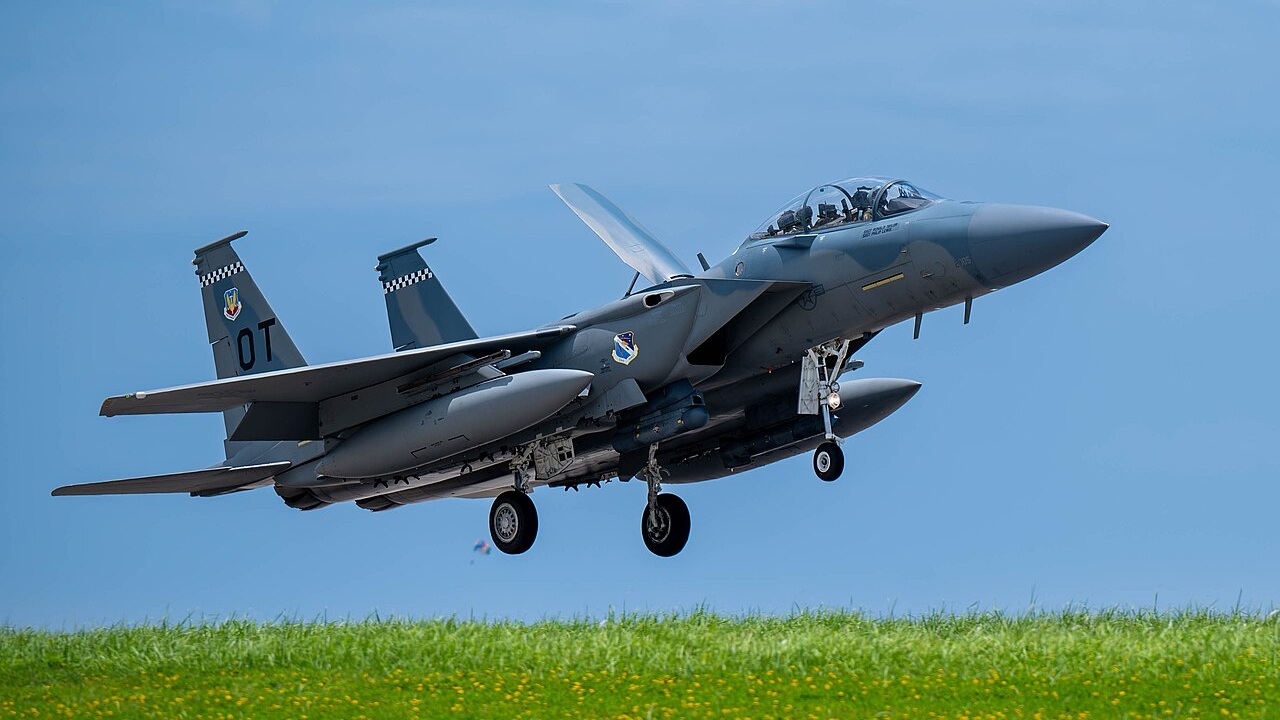
Built largely on the chassis of the existing F-15 Eagle, Boeing’s F-15EX Eagle II contains a multitude of fifth-gen internal upgrades.
Aerospace giant Boeing has touted its F-15EX Eagle II as a modernized variant of the venerable F-15 Eagle and F-15E Strike Eagle, ready for the challenges of the 21st century. At this week’s Dubai Airshow 2025, Boeing also highlighted a new role for the multirole fighter that remains undefeated in aerial combat.
The F-15EX would serve as a command-and-control platform for unmanned aerial systems (UAS), notably the United States Air Force’s collaborative combat aircraft (CCA) now in development, including its own MQ-28 Ghost Bat.
“We think that the future fight is really going to be about managing information,” said Brian Hartwig, a Boeing executive in the business development division, and a former US Navy fighter pilot, per Flight Global. “Yes, you have to be lethal, you have to be survivable… but the pilots and crews of tomorrow are going to have so much information that they have to manage, especially when we throw in MQ-28s and other CCAs in the future.”
The F-15EX Eagle II’s Specifications
- Year Introduced: 2021
- Number Built: 129+ (ongoing production)
- Length: 63.8 ft (19.44 m)
- Wingspan: 42.8 ft (13 m)
- Weight (MTOW): 81,000 lb (36,740 kg)
- Engines: Two General Electric F110-GE-129 afterburning turbofans
- Top Speed: 1,650 mph (2,655 km/h) / Mach 2.5
- Range: Approx. 2,762 mi (4,445 km)
- Service Ceiling: ~60,000 ft (18,300 m)
- Loadout: One internally mounted M61A1 20 mm six-barrel cannon with 500 rounds, 23 hardpoints for external fuel and ordnance (29,500 lb payload capacity)
- Aircrew: 2 (pilot and weapons systems officer)
The F-15EX is a two-seat fighter with capabilities unique to the US Air Force. That includes new fly-by-wire flight controls, improved weapons stations, and an enhanced electronic warfare suite, as well as advanced radar and computers, conformal fuel tanks, and a strengthened airframe. The Eagle II offers a deep magazine, allowing it to carry a load of advanced weapons, with a 28 percent larger payload than the older F-15E Strike Eagle variant. At the same time, the Eagle II will require only minimal additional training for existing F-15 pilots, and little additional manpower from the older versions of the F-15.
Boeing’s F-15EX Is a C&C Aircraft in the Making
A key advantage the F-15EX could have, even over the fifth-generation F-35 Lightning II, is that it is a two-seat aircraft that can carry both a pilot and a weapons systems officer (WSO). That could enable it to function more effectively as a command-and-control node for UAS.
Boeing had previously touted these capabilities, but reinforced its pitch in Dubai, where it offered a video demonstration of the future of air combat. In the presentation, multiple MQ-28s provided additional situational awareness, serving as scouts, passing data back to the manned fighter.
In this way, the F-15EX would serve as a type of “quarterback” with the unmanned drones acting as the blockers. The pilot would fly the plane, and the WSO could call the “plays” to the drones.
“That’s really what we see as the future: using unmanned assets to push further downrange, reduce risk for the manned platform… while increasing lethality and survivability for the manned platform,” Hartwig added.
The F-15EX Isn’t a Stealth Plane—Fortunately, That Doesn’t Matter
The F-15EX isn’t a stealth fighter, but as it would operate far beyond visual range, that might not be an issue. As a flying “weapons truck,” it would be well-armed to deal with numerous threats, and the CCAs would extend its ability to track them.
As the aircraft is also outfitted with the new Eagle Passive Warning Survivability System (EPAWSS) for enhanced electronic warfare capabilities, it is already considered to be among the best non-stealth fighters in service.
The Eagle II isn’t yet in large numbers, but in May, Boeing announced that as many as 90 additional fighters would be “hatched” this year, with deliveries of Lot 2 beginning.
The first operationally configured Eagle II was delivered to the Oregon Air National Guard last June, while a second one completed deliveries of Lot 1 orders to the ANG unit last summer. The 173rd Fighter Wing at Kingsley Field Air National Guard Base (ANGB), Oregon, became the first F-15EX formal training unit in 2024.
About the Author: Peter Suciu
Peter Suciu has contributed over 3,200 published pieces to more than four dozen magazines and websites over a 30-year career in journalism. He regularly writes about military hardware, firearms history, cybersecurity, politics, and international affairs. Peter is also a contributing writer for Forbes and Clearance Jobs. He is based in Michigan. You can follow him on Twitter: @PeterSuciu. You can email the author: [email protected].
Image: Wikimedia Commons.















.jpg)