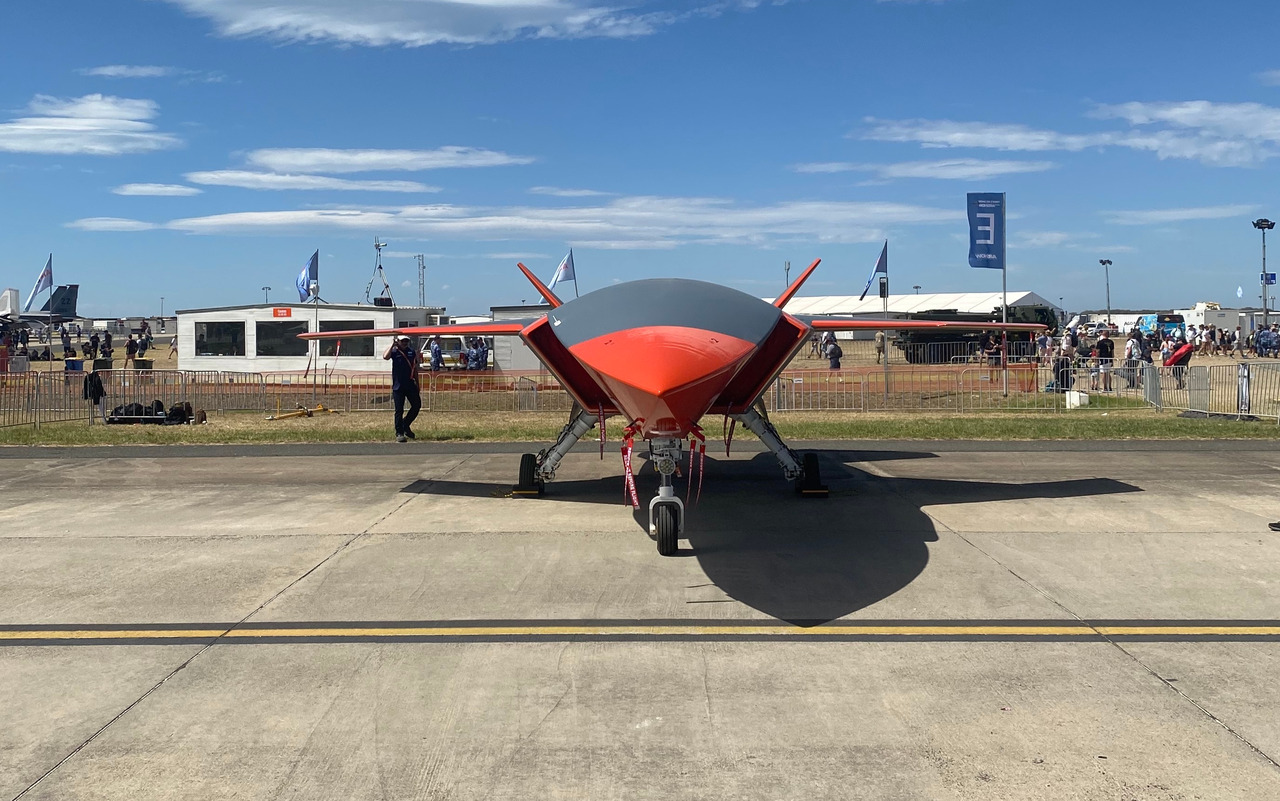
The Ghost Bat is an affordable combat mass option that can support other unmanned and manned assets.
The MQ-28 Ghost Bat drone is set to fire an air missile in December.
The promising Collaborative Combat Aircraft will test fire an AIM-120 AMRAAM munition as part of the Australian military’s evaluation process. This will be a first for the promising unmanned aerial system.
MQ-28 Ghost Bat & AIM-120 AMRAAM
In September, the Royal Australian Air Force (RAAF) successfully tested the unmanned aerial system for future operational deployment. The RAAF operates a small number of Ghost Bats and is validating their capabilities before they are fully incorporated into the operational fleet. Next month, the RAAF and Boeing are taking the MQ-28 evaluation a step further by testing whether the unmanned aerial system can deploy advanced air-to-air munitions.
According to Steve Parker, president and CEO of Boeing Defense, Space, and Security, the test will take place next month. During a media roundtable ahead of the 2025 Dubai Airshow in the United Arab Emirates, Parker revealed that the testing will involve an AIM-120 Advanced Medium Range Air-to-Air Missile (AMRAAM).
Boeing executives previously indicated that the MQ-28 Ghost Bat will fire live weapons by the end of 2025 or early 2026.
The unmanned aerial system has already operated alongside other aircraft, including E-7 airborne early warning and control aircraft, performing a variety of fictional mission sets. The live-firing of an air-to-air munition is the next step in validating the drone’s viability as a collaborative combat aircraft.
According to Boeing, the MQ-28 Ghost Bat offers “fighter-like” performance with an operational range of over 2,000 nautical miles (approximately 2,300 miles). That is a remarkable range, making the unmanned aerial system particularly useful to air forces operating over vast distances of water, such as the Indo-Pacific Ocean.
Boeing advertises the Ghost Bat as an affordable combat mass option that can support other unmanned and manned assets.
“I think our Ghost Bat is uniquely positioned here, both from an air-to-air [and] air-to-ground perspective, as well as all the things we’ve already talked about, from an EW [electronic warfare] payload, radar, and so forth,” the Boeing executive added.
But the concept of the collaborative combat aircraft is still new, and air forces are still trying to determine how these unmanned aerial systems fit into their current and future operational fleets.
“The cold, hard facts of the matter are the customers are still trying to determine how they will employ these CCAs, and tactics, and what you need,” Parker said.
If the testing proves successful, the US Navy or Marine Corps might also become more interested in the drone.
The AIM-120 AMRAAM’s Specs
The AIM-120 AMRAAM is an all-weather, radar-homing guided air-to-air missile. Alongside the AIM-9X Sidewinder, the AIM-120 is one of the two main air-to-air missiles used by the US military. Here are the missile’s characteristics:
- Year Introduced: 1991
- Warhead: Blast fragmentation
- Guidance System: Active radar terminal/inertial midcourse
- Length: 143.9 inches (366 centimeters)
- Wingspan: 20.7 inches (52.58 centimeters)
- Weight: 335 pounds (150.75 kilograms)
- Top Speed: Mach 4 (roughly 3,100 miles per hour)
- Range: 75 and 100 miles
- Service Ceiling:
- Unit Cost: $1,095,000
About the Author: Stavros Atlamazoglou
Stavros Atlamazoglou is a seasoned defense journalist specializing in special operations and a Hellenic Army veteran (national service with the 575th Marine Battalion and Army HQ). He holds a BA from the Johns Hopkins University and an MA from the Johns Hopkins’ School of Advanced International Studies (SAIS). His work has been featured in Business Insider, Sandboxx, and SOFREP.
Image: HoHo3143 – Own work, CC BY-SA 4.0, Wikimedia Commons, resized.