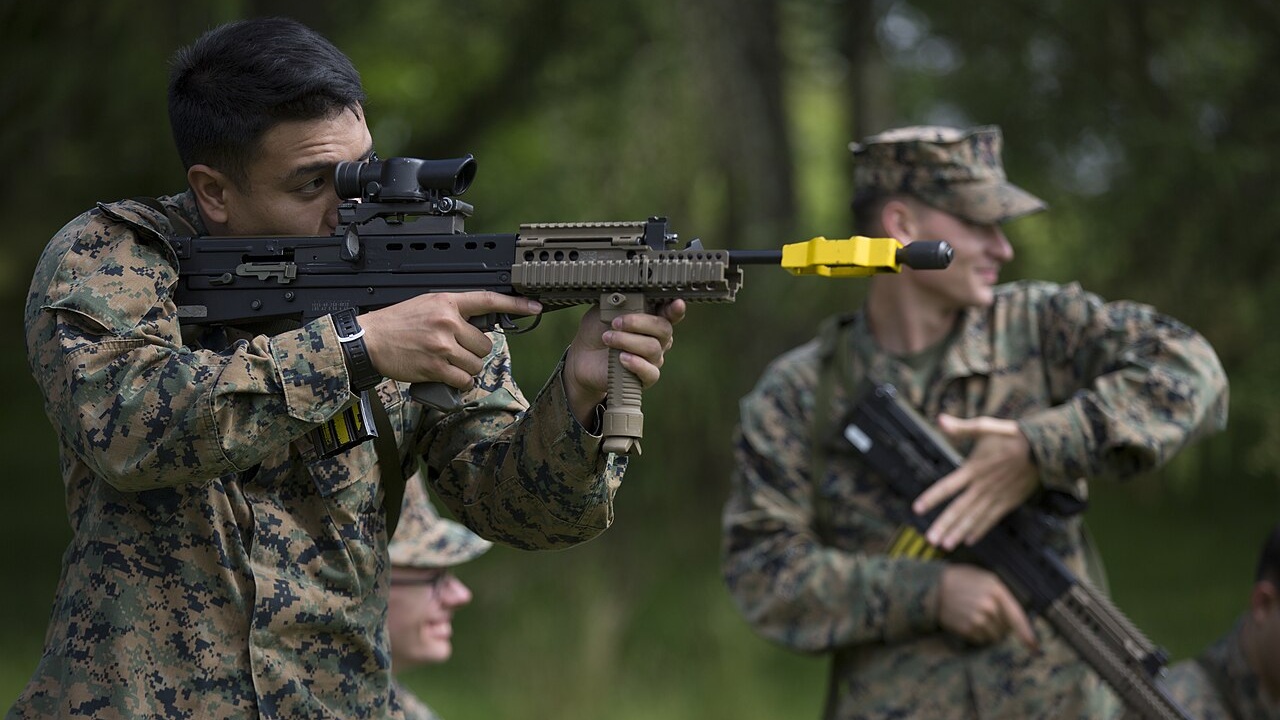
The bullpup-style SA80 service rifle has caused the British Army no small number of headaches—but it is unclear what other weapon it might choose instead.
The United States military has continued testing its M7 rifle and M250 automatic rifle, the new small arms chosen to replace the legacy M4 carbine and M249 light machine gun. Across the Atlantic, the United Kingdom, America’s closest ally, is also in the process of determining what will succeed its current battle rifle.
The British Armed Forces have used the SA80, a variant of the bullpup L85 now produced by Heckler and Koch, since the 1980s. It was adopted as part of the Small Arms for the 1980s program, hence its SA80 designation. Despite its futuristic appearance, the bullpup rifle suffered early problems and was found to be ill-suited for operations in the Middle East during the Global War on Terror (GWoT), where dust and sand caused frequent jams.
Efforts were made to address the issue. The SA80 A3 models include both the Individual Weapon (IW) and the Light Support Weapon (LSW), and the current timeline calls for it to remain in service until the mid-2030s, which would be nearly as long as the British military used its now infamous bolt-action Lee Enfield rifle.
Yet the Ministry of Defence has begun the process of determining its eventual replacement with its Project Grayburn. Among the considerations is whether the UK’s armed forces will take a similar route to the US military and adopt a new cartridge, or stick with the widely employed 5.56x45mm NATO round.
There have also been calls for the UK to look to the 6.8x51mm Common Cartridge developed for the US Next Generation Squad Weapon, including the M7 and M250. Another candidate would be the 6.5mm Creedmoor round, as it is currently employed by the Royal Marines with the L129A2 designated marksman rifle.
The UK Has Long Experimented with New Rifles
Prior to the adoption of the SA80 in 1985, the British Army carried the L1A1 Self-Loading Rifle (SLR), the UK’s version of the Belgian-made FN FAL. Officially adopted in 1954, the L1A1 saw use throughout much of the Cold War, including operations in Northern Ireland, the Malayan Emergency, the Suez Crisis, and the Falklands War. It was phased out of service entirely by 1994, in favor of the SA80.
The British military used the Lee Enfield from 1895 to 1957, though it underwent several notable upgrades. Introduced initially as the Magazine Lee-Enfield (known today as the “Long Lee”), the “Rifle, Short, Magazine, Lee-Enfield (SMLE) was introduced in 1904. Both versions saw service in World War I, and the No. 4 Mk I rifle was upgraded in the early stages of World War II—serving as the UK’s primary service rifle throughout the six-year conflict.
Of course, neither the Lee Enfield nor the SA80 would have the distinction of being the longest serving British long gun. That distinction belongs to the muzzle-loading smoothbore Land Pattern Musket, more commonly known as the “Brown Bess,” which was introduced in 1722 and saw combat all over the world as the British Empire began to spread. The final Brown Bess muskets were not retired from British inventories until 1867—giving the gun an unparalleled service life of 145 years!
Two Options for the SA-80 Rifle’s Successor
Project Grayburn will determine the cartridge and the layout of the weapon, whether it will feature a conventional design like the American M7 or retain a bullpup design like the L85, where the action and magazine are placed behind the trigger group.
There are at least two options to replace the SA80, according to the international open-source military intelligence firm Janes. It reported that current bids include the Beretta New Assault Rifle Platform (NARP) and Sako Arctic Rifle Generation (ARG) assault rifles for dismounted close combat (DCC) and combat support (CS) roles.
As seen throughout the UK’s long history, the British Army doesn’t like to change rifles often, so the selection process may not be quick—and whatever rifle is chosen could remain in service throughout much of the 21st century.
About the Author: Peter Suciu
Peter Suciu has contributed over 3,200 published pieces to more than four dozen magazines and websites over a 30-year career in journalism. He regularly writes about military hardware, firearms history, cybersecurity, politics, and international affairs. Peter is also a contributing writer for Forbes and Clearance Jobs. He is based in Michigan. You can follow him on Twitter: @PeterSuciu. You can email the author: [email protected].
Image: Wikimedia Commons.