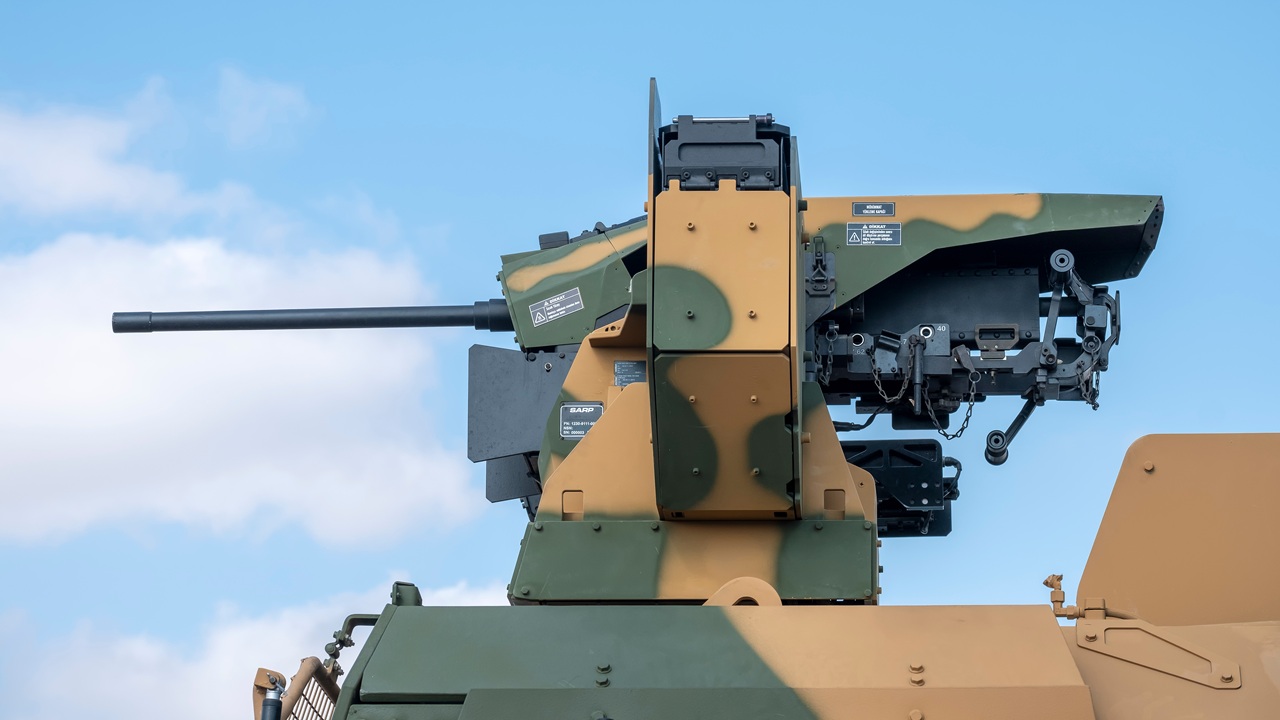
In recent tests arranged by Turkish manufacturer MKE, the SHORAD system achieved an astonishing 100 percent kill rate against enemy drones.
The Turkish state arms manufacturer, Mechanical and Chemical Industry Corporation (MKE), conducted live-fire trials of the Tolga SHORAD system at the Karapinar Firing, Test, and Evaluation Center. Around 100 observers from the Turkish Armed Forces and other security agencies were present. Over eight different engagement scenarios, the system achieved a 100 percent success rate in defeating drones—both via “soft kill” (electronic warfare/jamming methods) and “hard-kill” (with guns and/or cannons).
This represents a major development for Turkey, which is already advancing at breakneck speeds toward becoming a major arms distributor on the global market. An arms distributor that specializes in next-generation warfare platforms, such as drones (and now, in areas like counter-drones).
Why Is Turkey Pouring Money into Its Military?
Not only is Turkey becoming a major global arms exporter, but its military is increasingly advanced. What Ankara has done in terms of making Turkey an indispensable drone producer—notably in Ukraine—is to ensure that its leaders’ neo-Otttoman vision stands a chance at being realized.
By becoming a major contributor to the global arms market, and having a clear strategy for dominating that market, Ankara is also ensuring it stays relevant in an age when many previous great powers are consigning themselves to the dust.
Understanding the SHORAD System
The SHORAD system uses a combination of radar and electrooptical sensors, along with those aforementioned electronic warfare (EW) tools to detect and classify aerial threats out to about 6.2 miles.
The system packs quite a wallop. For hard-kill engagements, it has a 12.7mm rotary gun, a 20mm cannon with anti-drone fragmentation rounds, and a 35mm gun for longer range engagements. This system supports manual, semi-autonomous, and fully autonomous modes of operation. What this capability allows is for Turkish troops to have greater flexibility depending on the threat and mission they are on.
As for the soft-kill mode on the SHORAD: it can disable a hostile unmanned aerial vehicle (UAV) at around three kilometers out.
For Turkey, this is a milestone in domestic air-defense capabilities. Having a SHORAD system that can credibly deal with low-altitude aerial threats, especially in the drone era. From a broader vantage point, the supposed 100 percent kill rate in demonstrations is a strong signal, both for domestic audiences and for potential foreign buyers. What’s more, with cheap and deadly first-person view (FPV) drones increasingly accessible, systems like SHORAD matter more for defending mobile forces, critical infrastructure, and layered air-defense.
Anti-Drone Warfare Is the Next Big Thing
It also speaks to Turkey’s ambition to build an integrated “air shield” comprising multiple layers: very short-range, short-range, medium range, etc. It reinforces Turkey’s push for autonomy in defense tech rather than relying on imports.
The TOLGA SHORAD story illustrates how mid-tier powers, like Turkey, are closing the gap in air-defense and counter-drone technology—not just the major traditional powers. That creates more actors with credible deterrent capability. It also underscores the rising importance of soft-kill/electronic air defense countermeasures, not just missiles.
Turkey’s domestic production integration highlights just how states are trying desperately to avoid (or reduce) reliance on foreign sourcing.
About the Author: Brandon J. Weichert
Brandon J. Weichert is a senior national security editor at The National Interest. Recently, Weichert became the host of The National Security Hour on America Outloud News and iHeartRadio, where he discusses national security policy every Wednesday at 8pm Eastern. Weichert hosts a companion book talk series on Rumble entitled “National Security Talk.” He is also a contributor at Popular Mechanics and has consulted regularly with various government institutions and private organizations on geopolitical issues. Weichert’s writings have appeared in multiple publications, including The Washington Times, National Review, The American Spectator, MSN, and the Asia Times. His books include Winning Space: How America Remains a Superpower, Biohacked: China’s Race to Control Life, and The Shadow War: Iran’s Quest for Supremacy. His newest book, A Disaster of Our Own Making: How the West Lost Ukraine is available for purchase wherever books are sold. He can be followed via Twitter @WeTheBrandon.
Image: Shutterstock / Photo Oz.