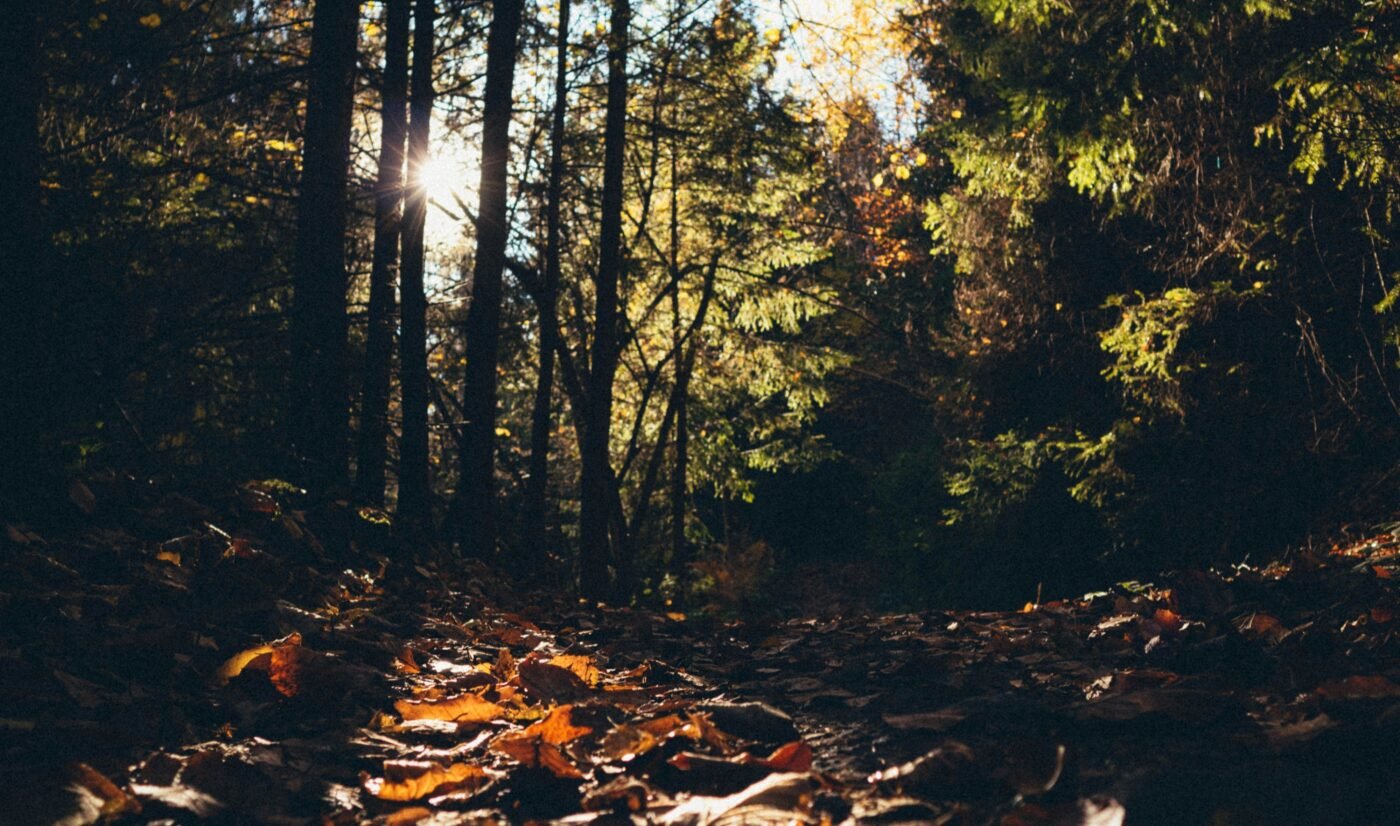
We are still in a season ripe for hiking, at least in my area of the country. The weather is at its most pleasant and stable, and the foliage at its most beautiful. Recently, my family and I took a day to hike in one of our state’s most beautiful and iconic parks. Few natural settings and physical activities offer such a rich opportunity to encounter and commune with the Lord.
As I hiked, two psalms kept coming into my mind and heart. The first of these ancient hymns helped put words to my gratitude for—and awe at—creation. The second helped cultivate in me a disposition to listen to God’s direction for my life. In short, these two psalms opened a deep and fruitful conversation with the Heavenly Father. I hope the themes that came out of my own encounter might assist others.
A Psalm on Creation
The first is Psalm 104. It makes a marvelous meditation on the glory of God known through creation, whether hiking the amazing trails of the Southeast, walking along Lake Michigan, climbing the Rocky Mountains, or visiting a beach. The first five verses provide a memorable introduction, a prayer that anyone will do well to utter as he or she encounters the temple of creation:
You are clothed with splendor and majesty, covering yourself with light…he makes the clouds his chariot; he rides on the wings of the wind…He set the earth on its foundations so that it should never be moved.
After that, the psalm identifies several ways God’s glory is to be found in material creation. Mountains, valleys, and gushing springs are examples of geographic landforms (verses 8-10). “Birds of the heavens” and “wild donkeys” are among the wildlife, the innumerable creatures teeming from fields and oceans (v. 11-12, 24-25). There is a memorable depiction of foliage: “The trees of the Lord are watered abundantly…” (v. 16). It is well known—at least in the South—that an abundance of water throughout the year enables a beautiful array of fall colors from trees and leaves. It’s easy to move toward contemplative prayer as I view the colorful transformation of leaves during this season.
The psalm reminds me of other important realities beyond landforms. First, there is the evolution of days and seasons. Moon and sun, darkness and light, and beasts of the forest seeking sustenance all make an appearance (verses 19-22). The Psalmist clearly understands, though, that humanity is the crown of creation, and human work is the culmination of this picture: “Man goes out to his work and to his labor until the evening” (v. 23). God’s ongoing sustenance of creation—His providence—is the overarching truth here (v. 13, 29-30). I pray that the Holy Spirit will breathe upon my work and that my work, throughout all the seasons of my life, will give glory to the Lord even more prominently than landforms and cosmic activity.
The Psalmist reaches a crescendo when he recognizes that God provides everything from His open, generous hand (verses 27-28). This prompted me to respond in prayer, “God, I look to you to provide what I need. I know you have already opened your hand generously to me, and allowed my life to be filled with good things. Continue to be generous, and continue to give me the grace to recognize your gifts.”
A Psalm for Direction
As I began to consider hiking as a metaphor for the moral life, my mind and heart turned to Psalm 119. Trekking through the wilderness, scaling steep and difficult trails, and aiming for a destination require certain accoutrements. Light, sturdy equipment, sure steps, and a map are necessary, and all make fantastic analogies for our moral life of discipleship.
Psalm 119 expresses God’s revelation and the moral law as the light and direction any one of us needs. “I will meditate on your precepts and fix my eyes on your ways. I will delight in your statues; I will not forget your word,” the Psalmist prays (verses 15-16). “Open my eyes, that I may behold wondrous things out of your law” (v. 18). Probably best-known among the verses from this psalm: “Your word is a lamp to my feet and a light to my path” (v. 105). These verses elicit a connection in my mind and heart: while hiking, my open eyes allow me to see the material glory of the Lord, and spiritual insight allows me to see and know beauty on a deeper level.
Sturdy equipment is also essential for successful hikes because it aids in making sure steps. From early in the psalm, the author prays, “Oh that my ways may be steadfast in keeping your statutes!” (verse 5). Later, he admits that relationship with God is more fruitful when “I hold back my feet from every evil way, in order to keep your word” (v. 101). Nearing the end of the hymn, the author calls out to God, “You are my hiding place and my shield; I hope in your word” (v. 114); and “Hold me up, that I may be safe and have regard for your statues continually!” (v. 117). I am reminded of the safety and security wrought by God’s law, as the theme recurs all the way to the end: “Great peace have those who love your law; nothing can make them stumble” (v. 165).
The last significant point about hiking and the moral life that comes across in Psalm 119 is the necessity and benefit of a destination and direction. “My soul longs for your salvation…My eyes long for your promise,” the Psalmist opines (verses 81-82). Like a hiker adhering strictly to the map provided at the ranger station: “I do not turn aside from your rules, for you have taught me” (v. 102). And, finally, “My eyes long for your salvation and for the fulfillment of your righteous promise” (v. 123). Every great hike I have ever taken has culminated at a destination, just as my moral life is intended to culminate in the Beatific Vision.
The conclusion of Psalm 119 (verses 169-176) puts words to my feeling as I search for the Lord—whether I am hiking in the wilderness or going about my daily business in the neighborhood. I ask for my prayer to come before Him, and I ask for deeper understanding according to His revealed truth. I ask for deliverance and knowledge of His ways. I ask for the Lord’s steady hand to assist and guide me toward salvation, especially by keeping the statutes of His law.
While I hike, seeking beautiful vistas with my family—or solitude for meditation, I know God is seeking me, too, as the final line of Psalm 119 notes. “I have gone astray like a lost sheep; seek your servant, for I do not forget your commandments” becomes my prayer (verse 178). I pray that anyone who takes up a hike this season, or in the future, will benefit from taking these two psalms—Psalm 104 and Psalm 119—with them on the journey.
Photo by Taras Chuiko on Unsplash