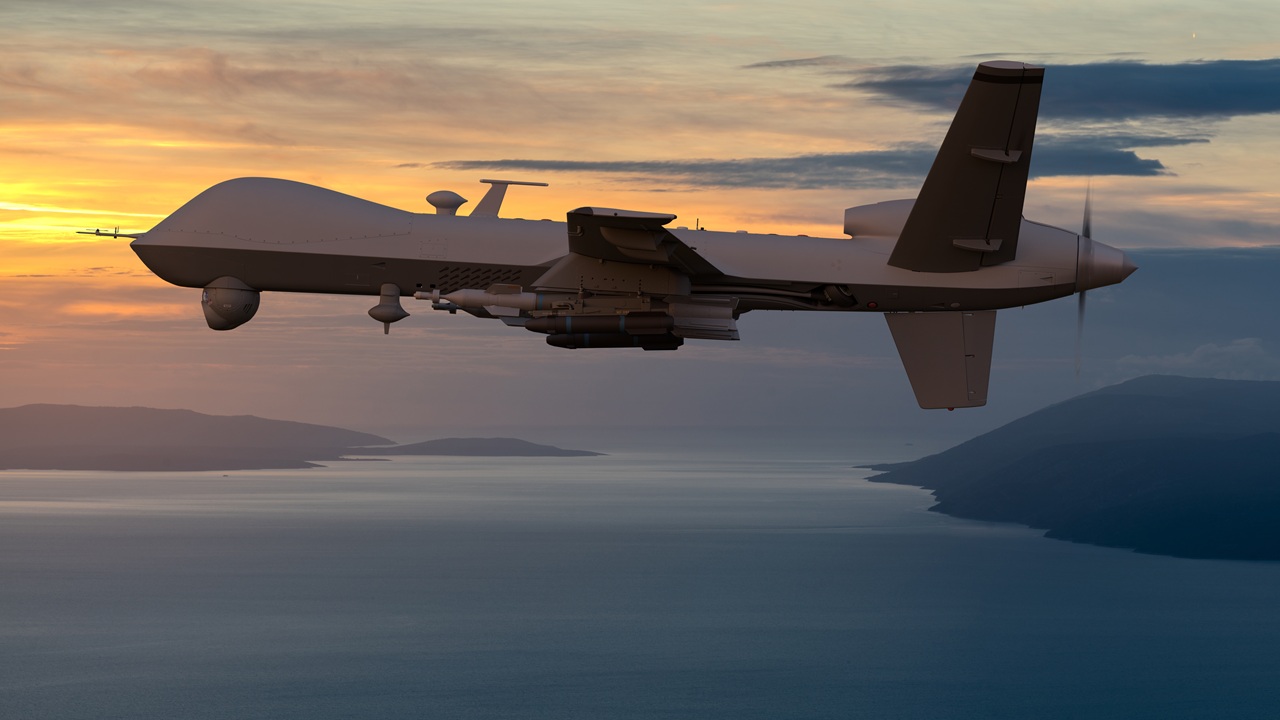
The Department of Defense has five separate categories for the UAVs in its arsenal—ranging from small handheld units to Reaper and Predator drones.
The United States Department of Defense categorizes unmanned aircraft systems (UAS) into five groups based on weight, operating altitude, and airspeed. These groupings are more than superficial designations; they determine mission roles, required infrastructure, regulatory airspace procedures, training demands, and cost profiles. The grouping system helps planners match the right drone to the right mission—everything from small-unit recon to global surveillance.
Group 1 UAVs
- Under 20 lb (9 kg)
- Operated below 1,200 feet above ground level (AGL)
- Slower than 100 knots (115 mph, 185 km/h)
- Portable / no runway required
Group 1 UAVs are used for tactical micro reconnaissance, short-range surveillance, target spotting, patrol overwatch, and route clearance. Designed for rapid deployment Group 1 UAVs can be launched by hand in mere seconds, with minimal maintenance and minimal training. And because Group 1 UAVs are so small, they are hard to detect—making them ideal for urban, jungle, and special operations missions. Examples in the American inventory include the Black Hornet Nano, RQ-11 Raven, InstantEye, and Skydio X series.
Group 2 UAVs
- 21–55 lb (9–25 kg)
- Operating up to 3,500 feet
- Typically below 250 knots (288 mph, 463 km/h)
- Medium portability; may use catapults to launch
Group 2 UAVs are used for battalion-level ISR and target acquisition with greater endurance and environmental tolerance than Group 1 systems. Group 2 UAVs provide real-time electro-optical/infrared feeds, comms relay, and spotting for indirect fires—especially artillery and mortar units.
Group 2 UAVs can also remain airborne for hours, withstand harsher winds, and operate over wider distances. Examples include the RQ-20 Puma AE, ScanEagle, Wasp, and Altius-600.
Group 3 UAVs
- 56–1,320 lb (25–600 kg)
- Operating up to 18,000 ft (5,486 m)
- Typically below 250 knots (288 mph, 463 km/h)
- Runway optional
Group 3 UAVs are used for high-end tactical ISR, surveillance, electronic warfare, communications extension, and sometimes precision strike. Group 3 fills the niche between man-portable systems and large Predator class drones, offering meaningful payloads and standoff range—without the heavy infrastructure footprint of Group 4 and 5 systems. Newer tail-sitting and VTOL designs enable dispersed, shipboard, and expeditionary deployment. Examples include the RQ-7 Shadow, Aerosonde HQW, V-BAT, Jump-20, and Anduril Omen.
Group 4 UAVs
- Above 1,320 lb (600 kg)
- Wide flight envelope
- Require runways
Group 4 UAVs are used for strike, ISR, maritime patrol, and armed overwatch. These aircraft operate for long durations and often integrate into air campaigns with precision weapons, SATCOM, and advanced sensors. Group 4 systems are quite expensive—requiring trained crews and dedicated hangars, making them less ideal for austere basing. Examples include the MQ-1 Predator, MQ-8 Fire Scout, and Turkish Anka-S
Group 5 UAVs
- Above 1,320 lb ()
- Regularly operate above 18,000 ft
- Long-endurance / strategic-level capability
- Require runways
Uses for Group 5 UAVs include long-range, persistent, theater-wide ISR and strike—often integrated with global C3 networks, satellites, and joint targeting cells. Group 5 systems can linger for longer than a day, carry sophisticated multi-sensor suites, deploy precision weapons, and deliver multi-theater awareness. Costly and complex, Group 5 UAVs are unique in their ability to influence strategic-level decision-making in real time. Examples include the MQ-9 Reaper, RQ-4 Global Hawk, MQ-4 Triton, and Bayraktar Akinci.
About the Author: Harrison Kass
Harrison Kass is a senior defense and national security writer at The National Interest. Kass is an attorney and former political candidate who joined the US Air Force as a pilot trainee before being medically discharged. He focuses on military strategy, aerospace, and global security affairs. He holds a JD from the University of Oregon and a master’s in Global Journalism and International Relations from NYU.
Image: Shutterstock / Mike Mareen.