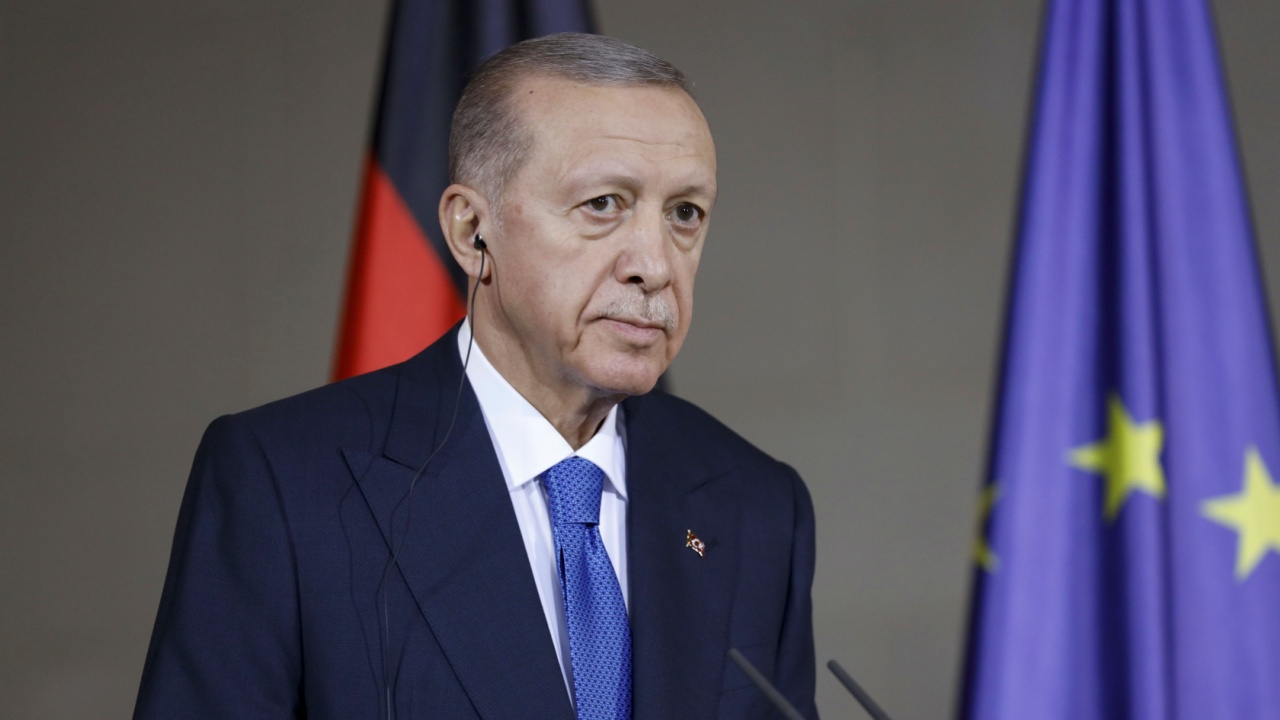
Why Hasn’t the EU Given up on Turkey?
Despite President Erdogan’s continued assault on Turkish democracy, Europe is still interested in bringing the country into the union.
There are no limits to the extent some people are prepared to go to hold on to power. This is more apparent in an autocratic system than in a democratic one. Russian president Vladimir Putin’s hold on power is determined by the outcome of his war on Ukraine, and his new nuclear-powered Burevestnik cruise missile and Poseidon drone are indicators.
In Turkey, the aging autocrat, Recep Tayyip Erdogan, has his back to the wall, and now he has announced “a new juncture” in the Kurdish peace process. To hardened observers of the Turkish scene, this is old wine in a new bottle.
Turkey’s Kurds first became a problem with the Sheikh Said rebellion in 1925. Said was the head of an influential religious order, and Mustafa Kemal’s secular reforms (the abolition of the Caliphate and the abrogation of Sharia law) reduced their power.
The Treaty of Sèvres in 1920 partitioned Turkey and the creation of an autonomous Kurdistan. Still, after the War of Independence, this was superseded by the Lausanne treaty in 1923, which defined the borders of modern Turkey. Said called for an independent Kurdistan and the restoration of the Caliphate, but this incipient Kurdish nationalism consolidated Kemalist reforms and Turkish nationalism.
The PKK (Kurdistan Workers’ Party), formed in 1978, supports an independent Kurdistan and led an armed struggle in the 1980s and 1990s. Its founder, Abdullah Öcalan, was captured in 1999.
In 2005, Erdogan made a keynote speech in Diyarbakir, the regional capital of Turkey’s mainly Kurdish southeast, where he admitted Turkey had a “Kurdish problem” that needed to be addressed, the first Turkish prime minister to do so. This speech could also be seen as a call for support from the Kurdish diaspora.
Behind the scenes, for example, in the “Oslo process,” which secretly took place between 2008 and 2011, a ceasefire was brokered in 2013. At the end of February 2015, a 10-point peace plan, the Dolmabahce Agreement, was negotiated between the Justice and Development Party (AKP) government and the pro-Kurdish HDP (Peoples’ Democracy Party), paving the way for a settlement.
However, in March, at a meeting of the HDP, its joint head, Selahattin Demirtas, declared three times that they would not make Erdogan president. After the HDP’s success in the June parliamentary elections, where it gained 80 of the parliament’s 550 seats and the AKP lost its majority, Erdogan turned his back on the agreement. In July, in a bait-and-switch deal, Erdogan offered Obama the Incirlik air base and, in return, reignited the war against the Kurds.
Demirtas was detained in 2016 on terrorism-related charges and later sentenced to 42 years in prison. Erdogan has declared he will never be released as long as he is president.
Erdogan’s track record as a jailer is impressive. Now he has not only locked up his main rival for the presidency, Istanbul’s mayor, Ekrem Imamoglu, but also he is busy dismantling his main opposition, the CHP (Republican People’s Party), founded by Atatürk, by imprisoning their mayors and replacing them with government-appointed trustees.
Now the situation has become surreal. The Istanbul public prosecutor has presented an indictment of almost 4,000 pages against Imamoglu, carrying a prison sentence of 2,342 years.
In October, an Ankara court found that an attempt to remove Özgür Özel, who had been elected leader of the CHP in November 2023, “had no basis.” Still, the AKP government continues its efforts to suppress the opposition. Now, the Turkish parliament has opened proceedings to remove the parliamentary immunity of 12 deputies, including Özel, as the first step toward bringing criminal charges against them.
Erdogan is bending over backwards in his attempts to manipulate Turkey’s parliament to garner enough support to change the constitution and give him a new term as president.
The first step towards a rapprochement with the DEM (Peoples’ Equality and Democracy Party), the HDP’s successor, was taken at the opening of the parliamentary assembly in October 2024. Erdogan’s ally, Devlet Bahceli, leader of the MHP (National Movement Party), crossed the floor and shook the hand of the DEM’s co-chair.
Overtures were made to PKK leader Abdullah Öcalan, and DEM delegations met with him on the Imrali prison island. Bahceli called on Öcalan to urge the PKK to lay down its arms, and in February Öcalan did so, stating that Kurdish identity was no longer denied and that there had been improvements in freedom of expression.
How this squares with the removal of their legally elected mayors and the suppression of Kurdish culture is something that DEM deputies must explain if they support Erdogan’s ambition of a third term of office.
Nevertheless, in July, thirty PKK fighters destroyed their weapons at a symbolic ceremony in Iraqi Kurdistan. Erdogan hailed this as the dawn of “a terror-free Turkey.”
“The new juncture,” as Erdogan told a meeting of the AKP last Wednesday, consisted of possibly allowing a parliamentary commission to meet with Öcalan and agreeing to the release of Selahattin Demirtas. The European Court of Human Rights has rejected Turkey’s final appeal in this case, and Devlet Bahceli considers his release “beneficial for Turkey.”
Meanwhile, it is business as usual in Turkey. The government continues to crack down on the independent media and, in September, seized three TV channels. Reporters Without Borders (RSF) marked International Day to End Impunity for Crimes against Journalists by unveiling the profiles of 34 Press Freedom Predators who attacked journalists and the right to information in 2025. Turkey’s President Erdogan was included, as well as his deadly weapon, the charge of “insulting the president.”
Considering that Turkey is a candidate country and has as its strategic goal full EU membership, the European Union remains curiously indifferent. German Chancellor Friedrich Merz, on his recent visit to Ankara, was critical of the state of the rule of law in Turkey but stated that Germany wanted to see Turkey in the EU. Germany has approved the sale of Eurofighter Typhoon jets to Turkey, and Merz said, “We agree on one point—these aircraft will serve our shared security.”
However, Merz ignores, or is ignorant of the fact that Turkey (as a non-sanctioning country) imports Russian crude oil and, through its three refineries, exports oil products to G7+ countries (G7 member countries, EU member states, Australia, Norway, and Switzerland).
A report by CSD (Center for the Study of Democracy) and CREA (Centre for Research on Energy and Clean Air), “Sanctions hypocrisy,” found that in the first half of 2024, Turkey rose from being the 14th largest buyer of Russian crude oil before Russia invaded Ukraine, to the third largest importer (after China and India). In the same period, three Turkish refineries used $1.2 billion worth of Russian crude to produce oil products exported to G7+ countries.
Turkish foreign minister Hakan Fidan has also said that Turkey would like to be part of Europe’s nascent security structure and hopes for German help in accessing European defense funds.
However, the European Parliament’s Committee on Foreign Affairs noted in April that Turkey has asked to join BRICS+ and is considering joining the SCO (Shanghai Cooperation Organization). Turkey also has its NATO responsibilities.
Consequently, it expressed its concern about Turkey’s tendency to use this multi-vector approach to advance its interests without committing to a full-fledged cooperation with any of these alliances.
About the Author: Robert Ellis
Robert Ellis is a Turkey analyst and commentator. He is also an international advisor at RIEAS (Research Institute for European and American Studies) in Athens. He is a regular commentator on Turkish affairs in the Danish and international press. Earlier, he served as an advisor to the Turkey Assessment Group in the European Parliament and as a senior fellow at the Gatestone Institute in New York.
Image: Juergen Nowak / Shutterstock.com.
The post Why Hasn’t the EU Given up on Turkey? appeared first on The National Interest.