China’s recent naval deployment around Japan comes on the heels of a war of words between Beijing and newly-elected Japanese prime minister Sanae Takaichi over Taiwan.
Threats between Tokyo and Beijing have been popping off nonstop over the last week. The newly elected government of Prime Minister Sanae Takaichi in Japan indicated that it would defend Taiwan militarily against a Chinese attack. This, in turn, prompted Beijing to threaten to turn Japan into “a battlefield” if it tried to intervene on behalf of Taiwan.
Of course, China is not as threatened by Japan’s small military the way they are by the fact that Japan and the United States are linked together by a treaty of mutual cooperation and security.
If Japan got into a war with China over Taiwan, even if the Americans were planning to stay out of any Sino-Taiwan conflict, then Washington would have little choice but to wage war against China on behalf of Japan.
At least that’s what China thinks would happen—which explains their explosive response to Japan’s comments. Indeed, it got so bad for Japan that, after seeing how divided their people were on the issue of possibly waging war against their larger Chinese neighbors for Taiwan, Tokyo deployed a top diplomatic representative to Beijing to smooth things over. But tensions remain high.
China’s Wolf Warriors Set Sail Around Japan
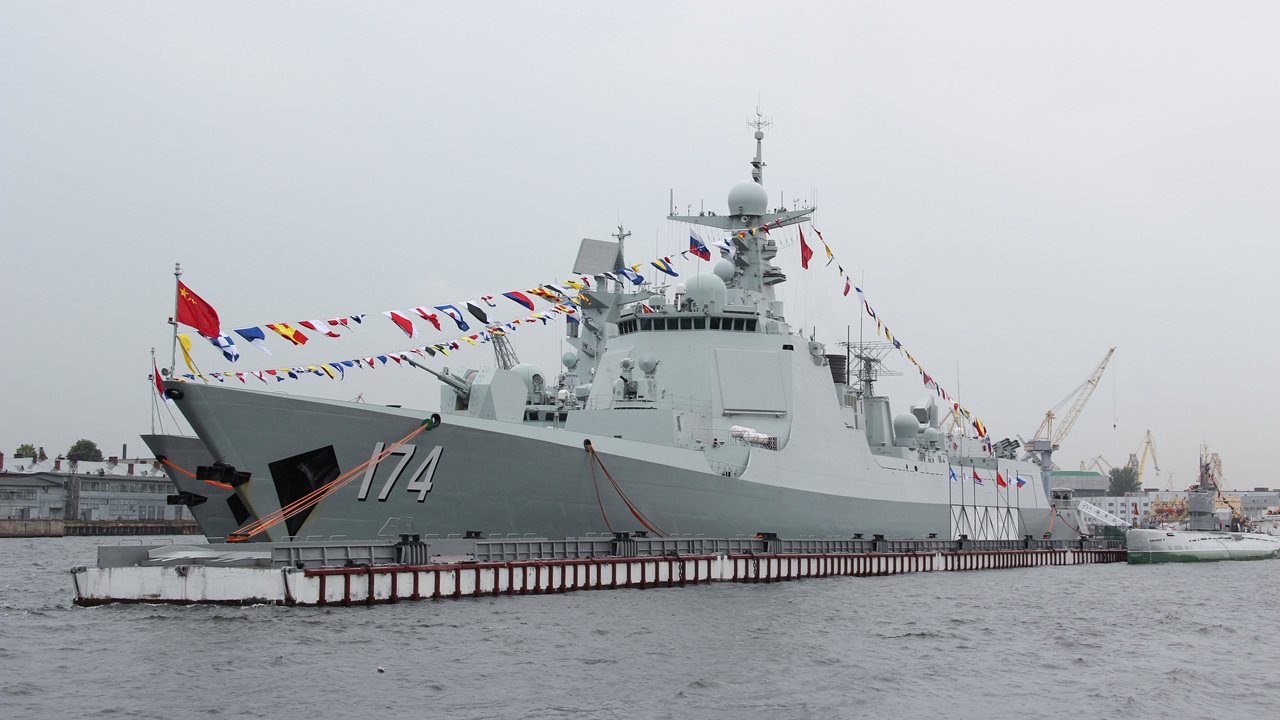
More recently, the Joint Staff of the Japan Ministry of Defense confirmed that three vessels from the People’s Liberation Army Navy (PLAN) transited eastward through the Osumi Strait into the Pacific Ocean on November 11. The vessels were identified as a Renhai-class destroyer seen around 120 kilometers west of Kuchinoerabu Island. A Jiangkai II-class frigate was observed later that day. Then there was a Fuchi-class supply ship transiting that same route.
Japanese military assets monitored the deployment of these PLAN ships. Japan’s Maritime Self-Defense Force (MSDF) even deployed the destroyer Yugiri, the missile boat Ootaka, and a minesweeper, the Awaji, to track the PLAN ships.
The Osumi Strait is an international waterway that cuts between the Kyushu and Ryukyu island chains. This waterway is frequently used by Chinese PLAN forces moving between the East China Sea and the Pacific—though it is under the watchful eye of increasingly concerned Japanese security officials. It is also a critical chokepoint in the southwestern Japanese archipelago region. Movements here, especially east of Kyushu, mean that PLAN vessels are maneuvering into the Pacific rather than just the East China Sea—potentially increasing cross-Pacific operational flexibility.
While not an explicit overt challenge to Japan, in the context of the breakdown of relations between Tokyo and Beijing, it is clear that Beijing’s transit was calculated to send a message—however subtle—to Washington about not getting ahead of itself when it came to protecting Taiwan from Chinese aggression.
China Is Trying to Intimidate Japan. Is It Working?
From a larger vantage point, movements of Chinese warships into areas proximate to Japan could serve multiple functions. They demonstrate a growing Chinese blue-water navy capability. This, in turn, will test Japanese monitoring and response patterns, and remind regional actors of China’s maritime ambitions.
By making public their desire to stand with Taiwan in the event of a Chinese attack on the island, Tokyo has placed a massive target on its back. It has also—quite shamelessly—attempted to lock in the Americans into moving in defense of Taiwan, believing that publicly announcing their will to go to war with China over Taiwan. In so doing, Tokyo’s new hawkish government just might be hoping to force an ambivalent Trump administration to more decisively assist in the defense of Taiwan.
The Chinese aren’t having it. All throughout the First Island Chain, Beijing is demonstrating a willingness and a real capability to rebuff the threats of its neighbors. Of course, war with Japan would not be an easy prospect. While small, Japan’s military is competent. And backed by the Americans, the Chinese might find that they have bitten off more than they can chew.
Ultimately, however, the future belongs to those willing to fight for it. China is not cowed by either Japan’s threats countering their brinkmanship against Taiwan. And the Americans appear to be recalcitrant about getting too involved in this particular fight—irrespective of whatever alliances they have with Japan or Taiwan.
About the Author: Brandon J. Weichert
Brandon J. Weichert is a senior national security editor at The National Interest. Recently, Weichert became the host of The National Security Hour on America Outloud News and iHeartRadio, where he discusses national security policy every Wednesday at 8pm Eastern. He is also a contributor at Popular Mechanics and has consulted regularly with various government institutions and private organizations on geopolitical issues. Weichert’s writings have appeared in multiple publications, including The Washington Times, National Review, The American Spectator, MSN, and the Asia Times. His books include Winning Space: How America Remains a Superpower, Biohacked: China’s Race to Control Life, and The Shadow War: Iran’s Quest for Supremacy. His newest book, A Disaster of Our Own Making: How the West Lost Ukraine is available for purchase wherever books are sold. He can be followed via Twitter @WeTheBrandon.
Image: Shutterstock / Massimo Vernicesole.