
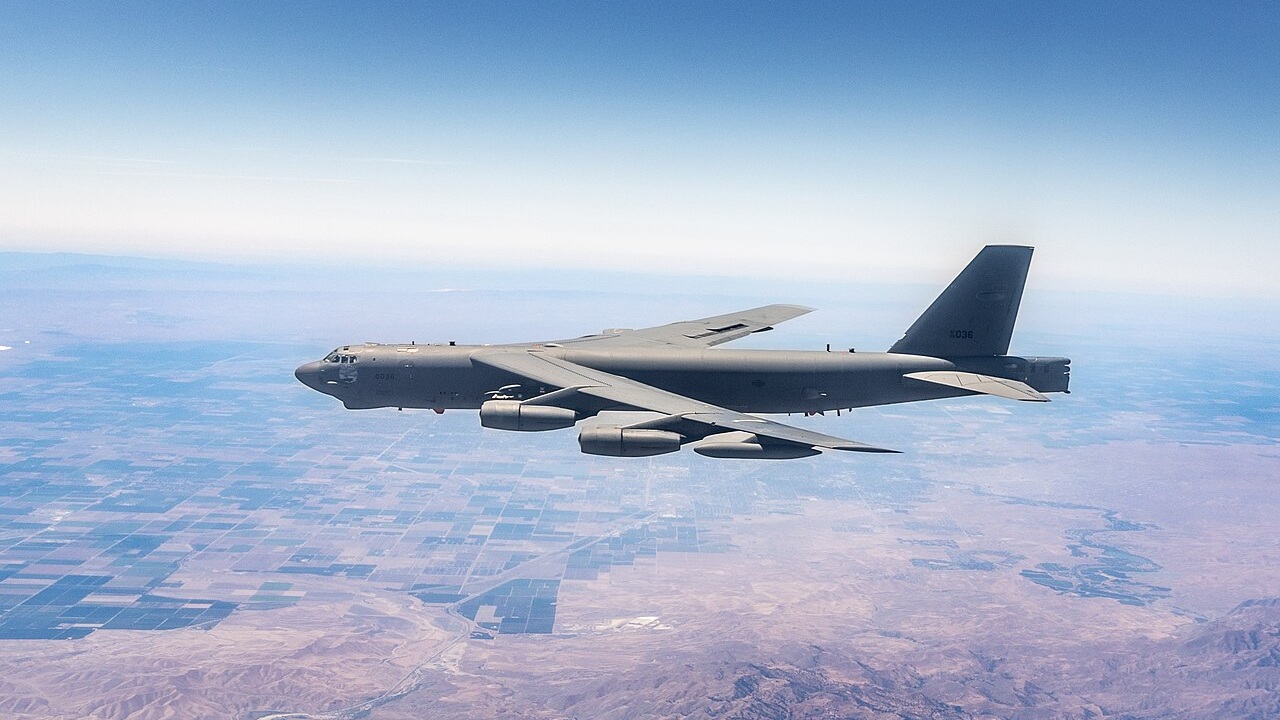
Many Cold War-era aircraft—particularly bombers and cargo planes—continue to serve in air forces around the world due to their ruggedness, simple design, and proven longevity.
The world powers are in a race to modernize their militaries—with the advent of artificial intelligence, hypersonic missiles, and autonomous vehicles. In the air, specifically, efforts are underway to field the world’s first sixth-generation fighters, while fifth-generation fighters are becoming more commonplace around the world. Yet despite the modernization efforts, many militaries—typically those of smaller nations with limited budgets, but also including the United States and Russia—still rely on decades-old airframes, some of which entered service at the onset of the Cold War.
This list intentionally excludes aircraft solely in use in a training capacity, such as North Korea’s continued use of the antiquated Korean War-era MiG-15. It only includes aircraft that are still in frontline military service—aircraft, in other words, that might conceivably see enemy combat if their operator entered an armed conflict.
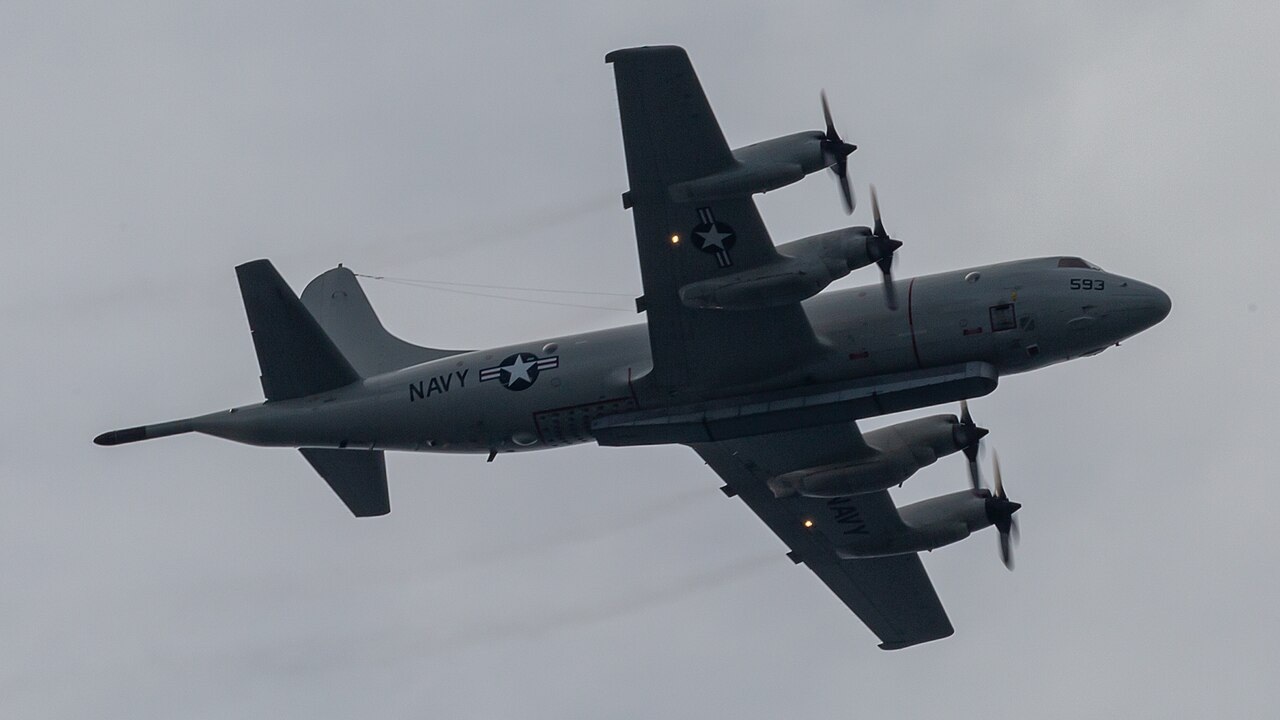
10. P-3 Orion (Surveillance Aircraft)
Introduced: 1962 (USA)
Operators: Japan, New Zealand, Canada, Chile, and others
- Year Introduced: 1962
- Number Built: ≈757
- Length: ≈116 ft (35.6 m)
- Wingspan: ≈100 ft (30.4 m)
- Weight (MTOW): ≈139,760 lb (63,440 kg)
- Engines: Four Allison T56-A-14 turboprop engines (~4,600 shp each)
- Top Speed: ≈475 mph (765 km/h)
- Range: ≈4,300 nmi (4,948 mi, 8,000 km)
- Service Ceiling: ≈28,000 ft (8,500 m)
- Loadout: ≈20,000 lb (9,070 kg) payload capacity; includes torpedoes, depth charges, mines, AGM-84 Harpoon missiles
- Aircrew: 11 (pilots, flight engineers, tactical crew)
Derived from the Lockheed Electra airliner, the Lockheed P-3 became the world’s premier submarine hunter during the Cold War. Equipped with magnetic anomaly detectors and long-range sensors, the P-3 patrolled oceans for decades.
Although the P-3 has largely been replaced with the P-8 Poseidon in the US Navy’s inventory from 2013 onward, it remains in limited use, and many other navies still use the P-3 for surveillance and patrol. The platform’s strong airframe, range, and adaptability make it viable for continued use.
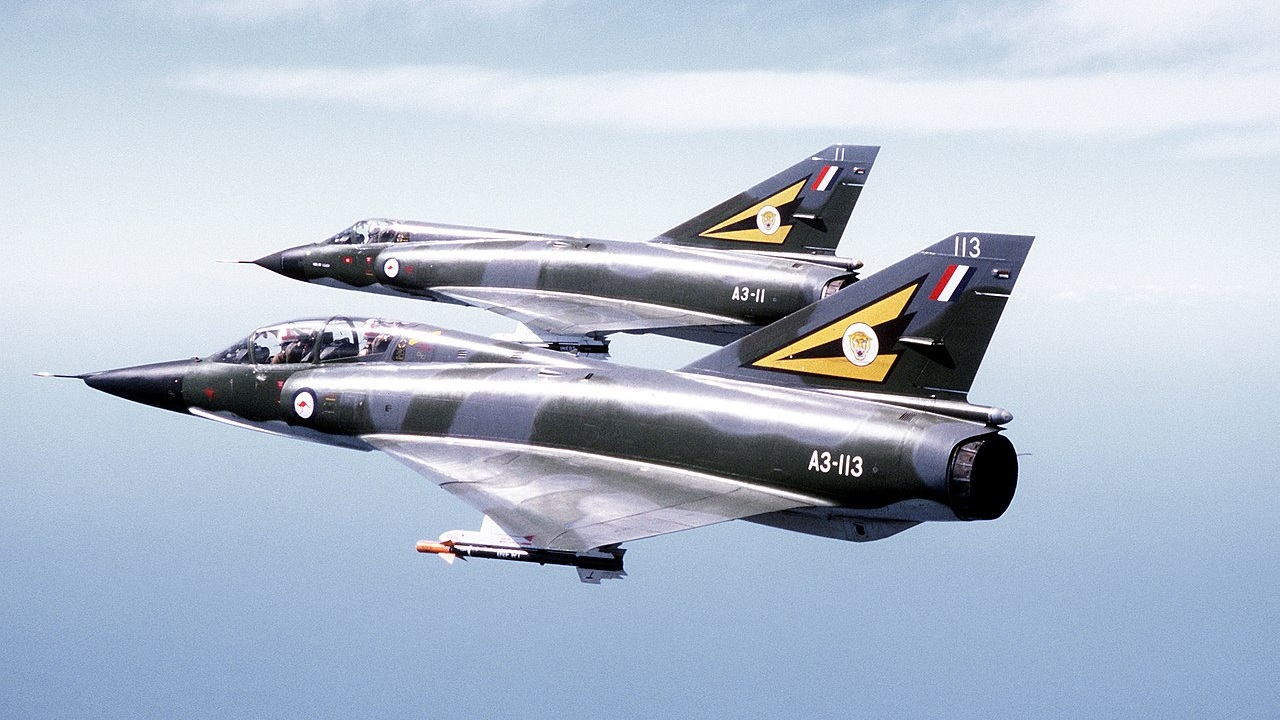
9. Mirage III (Fighter Jet)
Introduced: 1961 (France)
Operators: Pakistan
- Year Introduced: 1961
- Number Built: ≈1,400
- Length: ≈49 ft (15 m)
- Wingspan: ≈27 ft (8.2 m)
- Weight (MTOW): ≈30,900 lb (14,000 kg)
- Engine: One SNECMA Atar 09C turbojet (~13,700 lbf thrust w/ afterburner)
- Top Speed: ≈1,450 mph (2,335 km/h) / Mach 2.2
- Range: ≈740 nmi (851 mi, 1,370 km)
- Service Ceiling: ≈55,000 ft (16,800 m)
- Loadout: Two 30mm DEFA cannons; up to 8,000 lb (3,600 kg) of missiles and bombs
- Aircrew: 1
The Mirage III, first flown by France’s flagship aerospace firm Dassault in 1956, was Europe’s first successful Mach 2 fighter, an icon of the Cold War. Sleek, fast, and reliable, the Mirage III formed the backbone of many Western-aligned air forces during the 1960s-80s.
Although long-replaced in France, Pakistan continues to fly the Mirage III’s export version, with new radar and weapons systems. The plane’s longevity is owed to simple mechanics, a robust design, and its adaptability to modern avionics packages.
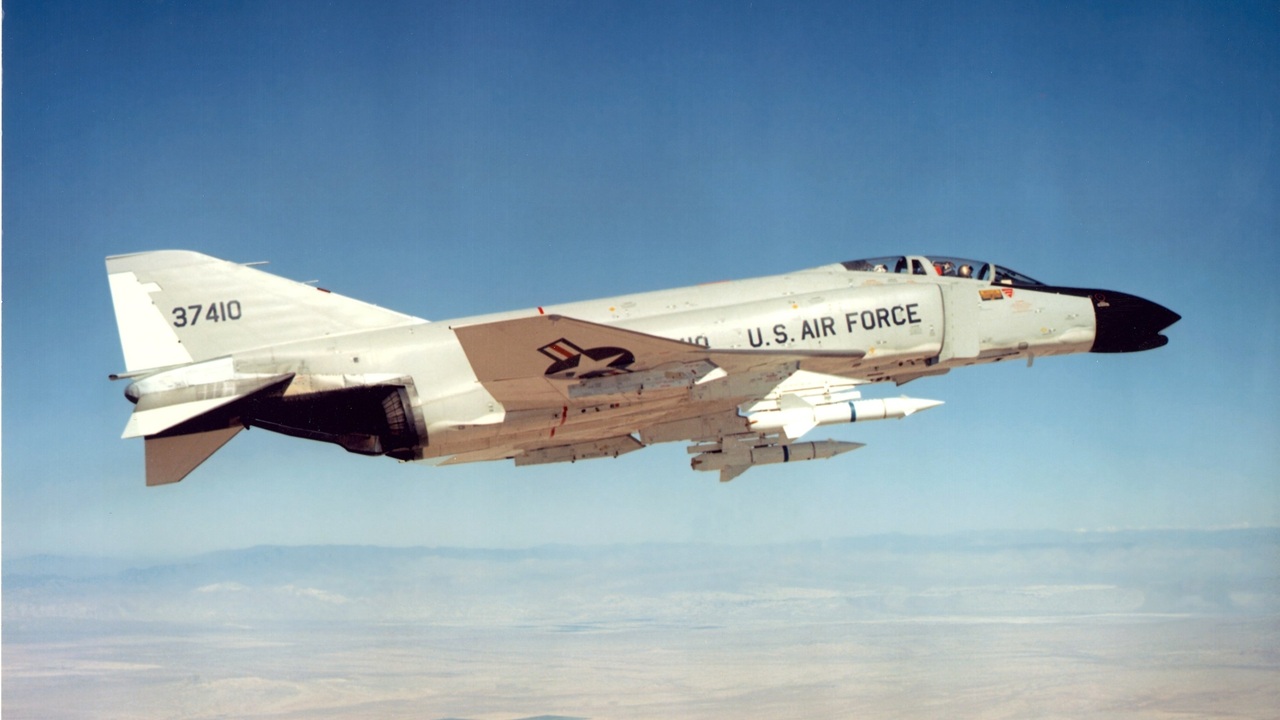
8. F-4 Phantom II (Fighter Jet)
Introduced: 1960 (USA)
Operators: Iran, Turkey
- Year Introduced: 1960
- Number Built: ≈5,195 (all variants)
- Length: ≈63 ft (19.2 m)
- Wingspan: ≈39 ft (11.7 m)
- Weight (MTOW): ≈61,800 lb (28,000 kg)
- Engines: Two GE J79-GE-17A turbojets (~17,900 lbf each with afterburner)
- Top Speed: ≈1,473 mph (2,370 km/h) / Mach 2.23
- Range: ≈1,600 nmi (1,841 mi, 2,965 km) ferry range; combat range varies widely depending on loadout
- Service Ceiling: ≈60,000 ft (18,300 m)
- Loadout: Up to ≈18,000 lb (8,164 kg) of ordnance; can carry AIM-7 Sparrow, AIM-9 Sidewinder, iron bombs, laser-guided bombs, AGM-65 Maverick, AGM-45 Shrike/AGM-78 SEAD missiles; internal cannon on later variants
- Aircrew: 2 (pilot and radar intercept officer)
The McDonnell Douglas F-4 Phantom II was arguably the defining Western fighter of the Cold War—a brute-force twin-engine interceptor turned multirole workhorse. Its raw power, massive radar, and heavy missile load made it a revolution in 1960, enabling beyond-visual-range engagements and all-weather strike missions.
In Vietnam, the Phantom became iconic: fast, rugged, and adaptable, eventually evolving into a premier dogfighter with upgraded slats, avionics, and guns. Today, only one country still flies the F-4 in its original condition: Iran, which inherited its Phantoms from the Shah and has continued to operate them despite being cut off from spare parts a generation ago. (Turkey also operates an improved version of the Phantom, with upgraded avionics courtesy of Israel.)
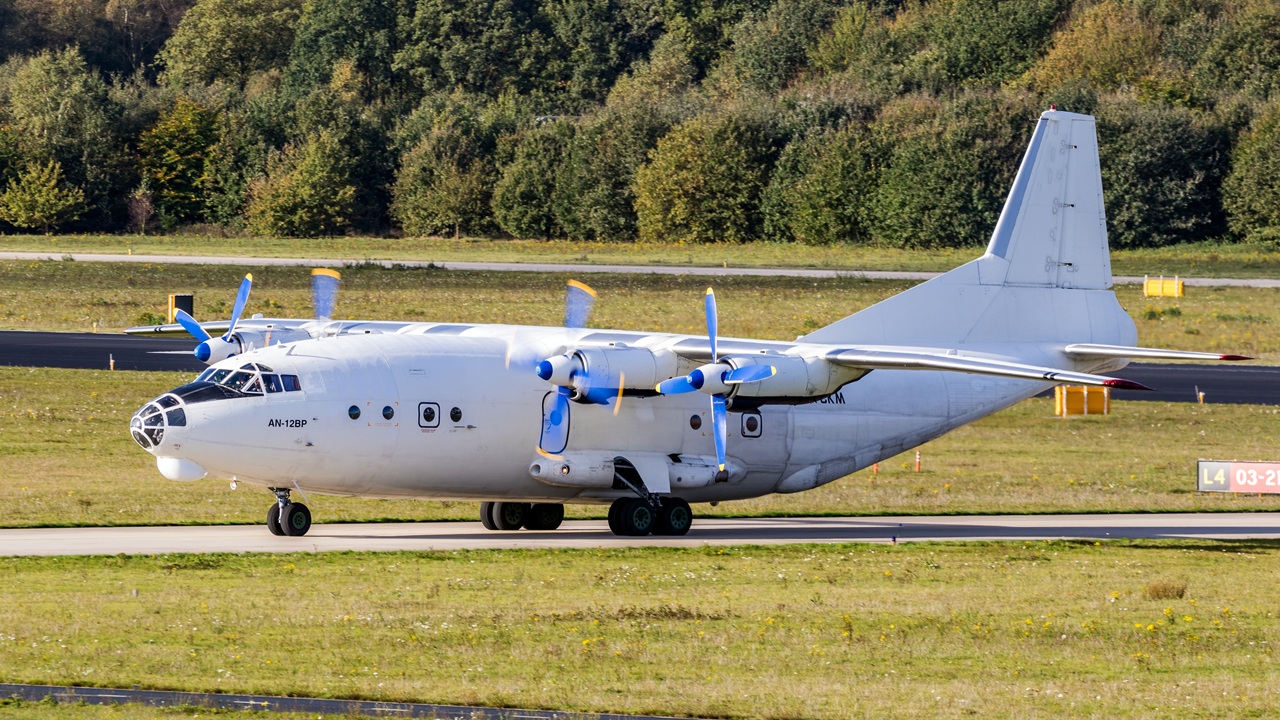
7. An-12 “Cub” (Cargo Plane)
Introduced: 1959 (USSR)
Operators: Russia, China, Sudan, and others
- Year Introduced: 1959
- Number Built: ≈1,200
- Length: ≈108 ft (33 m)
- Wingspan: ≈124 ft (37.5 m)
- Weight (MTOW): ≈132,000 lb (60,000 kg)
- Engines: Four Ivchenko AI-20 turboprops (~4,250 shp each)
- Top Speed: ≈410 mph (660 km/h)
- Range: ≈2,200 nmi (2,532 mi, 4,100 km)
- Service Ceiling: ≈35,000 ft (10,700 m)
- Loadout: ≈44 troops or ≈20,000 lb (9,071 kg) cargo; defensive tail guns in early models
- Aircrew: 5 (pilot, co-pilot, navigator, flight engineer, radio operator)
Designed and built by the Antonov Design Bureau in Moscow, the An-12 was the Soviet counterpart to the C-130 Hercules cargo plane—simple, rugged, and dependable. With a rear cargo ramp and strong undercarriage, the An-12 was capable of operating from rough airfields.
Despite its age, numerous An-12s remain active in military and commercial roles, particularly in Africa and Asia. The simple design and widespread availability of spare parts have kept the An-12 in action for more than six decades.
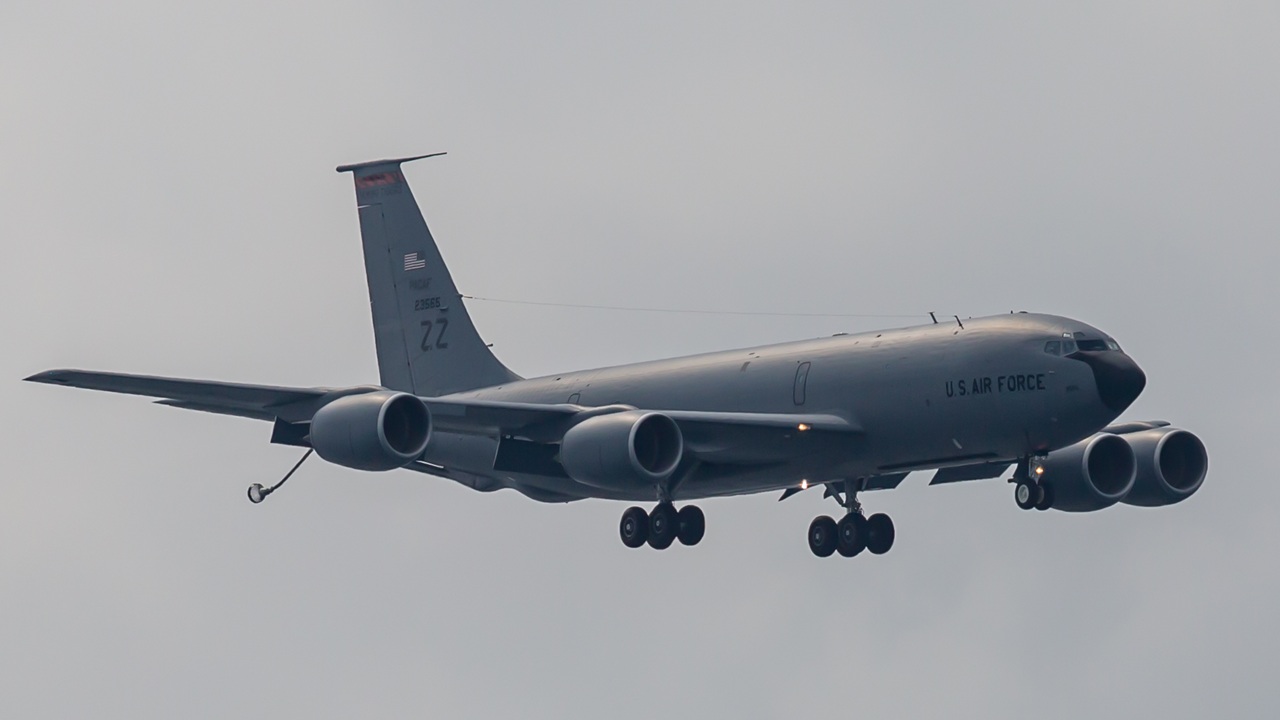
6. KC-135 Stratotanker (Cargo Plane / Tanker)
Introduced: 1957 (USA)
Operators: United States, France, Turkey, Singapore
- Year Introduced: 1957
- Number Built: ≈803 (≈400 still active worldwide)
- Length: 136 ft 3 in (41.5 m)
- Wingspan: 130 ft 10 in (39.9 m)
- Weight (MTOW): ≈322,500 lb (146,300 kg)
- Engines: Four CFM International CFM56 (F108) turbofans (~22,000 lbf each)
- Top Speed: ≈580 mph (933 km/h)
- Range:
- ≈1,500 nmi (1,726 mi, 2,780 km) with full offload
- ≈11,000 nmi (12,658 mi, 20,372 km) ferry range
- Service Ceiling: ≈50,000 ft (15,200 m)
- Loadout: ≈200,000 lb (90,718 kg) fuel for refueling; cargo and passengers secondary
- Aircrew: 3 (pilot, co-pilot, boom operator)
Built by McDonnell Douglas and based on the Boeing 707 airliner, the KC-135 has been the backbone of America’s global reach for nearly 70 years, allowing US bombers and fighters to project power worldwide. Upgraded with new engines, digital avionics, and structural reinforcements, the KC-135 remains reliable and efficient. The forthcoming KC-46 Pegasus will eventually replace the KC-135—but that won’t happen until sometime in the 2030s.
5. U-2 Dragon Lady (Surveillance Aircraft)
Introduced: 1956 (USA)
Operators: United States
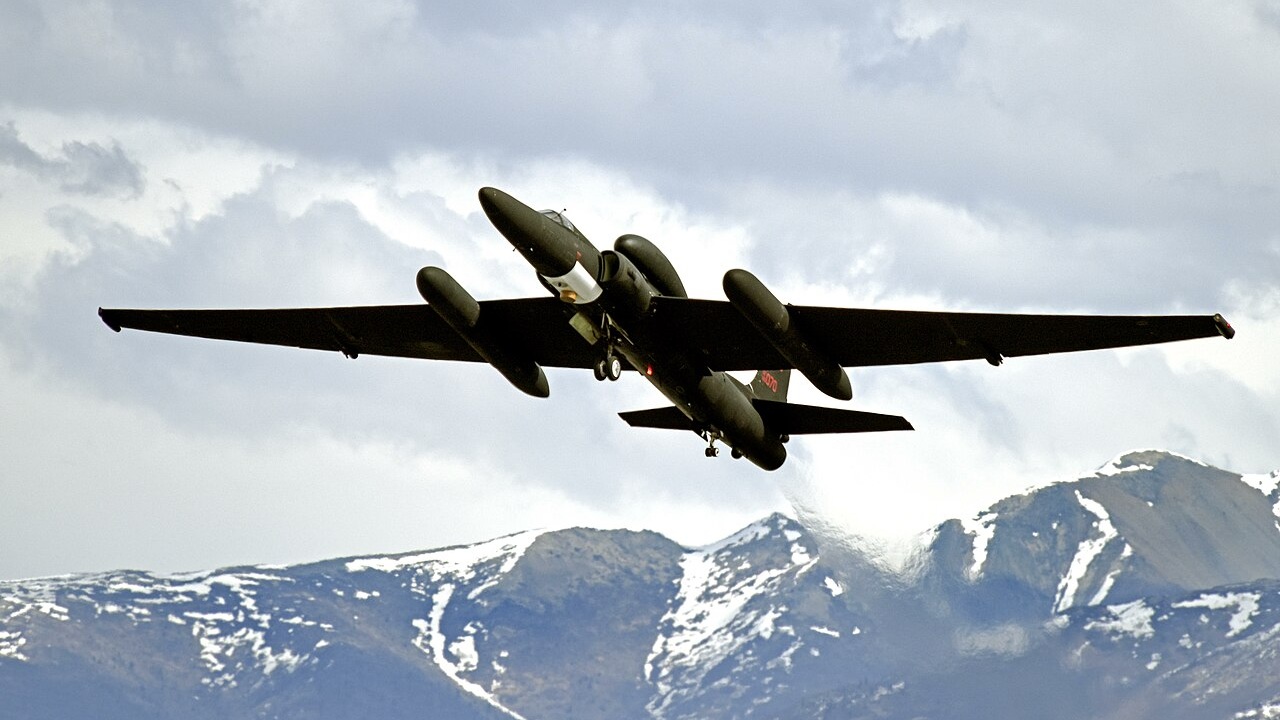
Designed and built by Lockheed’s legendary “Skunk Works” experimental aircraft division, the U-2 is a technical marvel and icon of the Cold War. Capable of flying above 70,000 feet, the U-2 is still capable of conducting ISR for the US Air Force; its ultra-high ceiling and advanced sensors make it invaluable for intelligence missions that satellites cannot cover in real time. Upgraded with digital sensors and datalinks, the U-2 remains viable, even with the proliferation of drones.
- Year Introduced: 1956
- Number Built: ≈104 (all variants)
- Length: ≈63 ft (19.2 m)
- Wingspan: ≈103 ft (31.4 m)
- Weight (MTOW): ≈40,000 lb (18,100 kg)
- Engine: One General Electric F118-GE-101 turbofan (~17,000 lbf)
- Top Speed: ≈500 mph (805 km/h)
- Range: ≈6,000 nmi (6,904 mi, 11,100 km)
- Service Ceiling: >70,000 ft (21,300 m)
- Loadout: Electro-optical and signals intelligence suites, advanced imaging systems
- Aircrew: 1
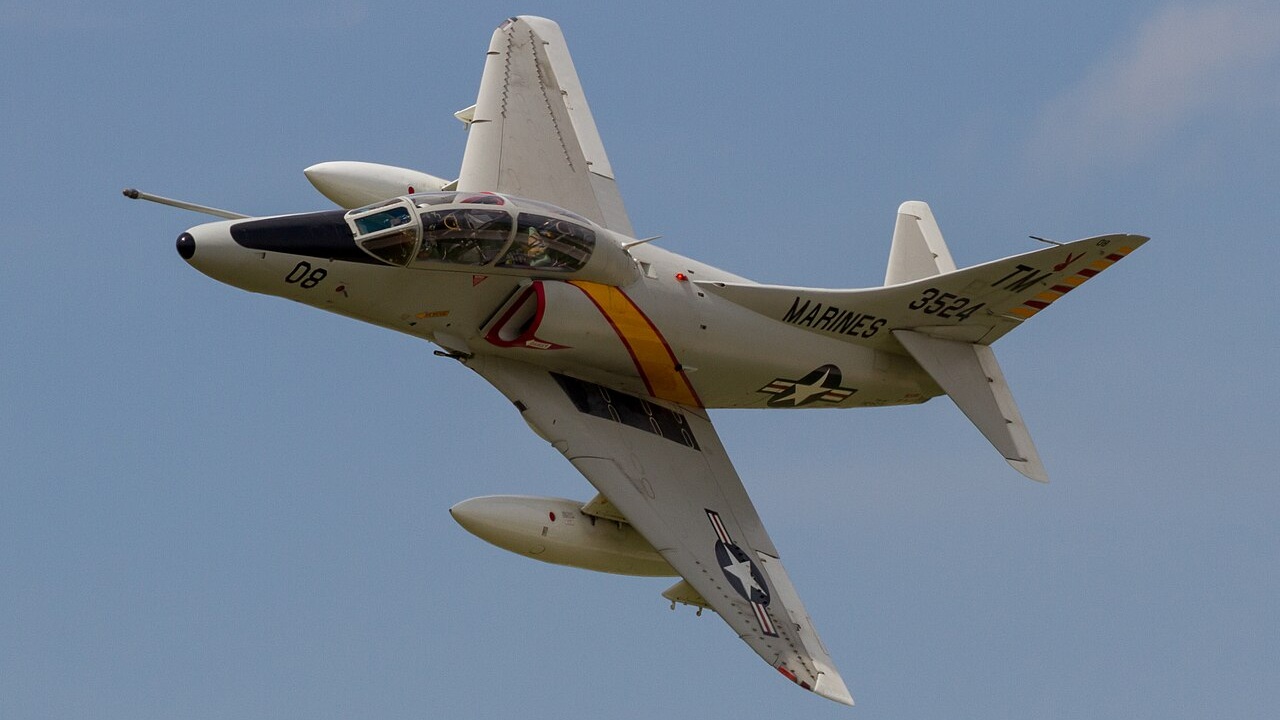
4. A-4 Skyhawk (Fighter Jet)
Introduced: 1956 (USA)
Operators: Argentina
- Year Introduced: 1956
- Number Built: 2,960; 36 still in service (32 A-4AR + 4 OA-4AR trainers)
- Length: ≈46 ft (14.1 m)
- Wingspan: ≈27.5 ft (8.4 m)
- Weight (MTOW): ≈24,500 lb (11,100 kg)
- Engine: One Pratt & Whitney J52-P-408A turbojet (~11,200 lbf thrust)
- Top Speed: ≈670 mph (1,078 km/h) / Mach 0.9
- Range: ≈1,700 nmi (1,957 mi, 3,150 km) ferry range
- Service Ceiling: ≈42,250 ft (12,880 m)
- Loadout: ≈8,200 lb (3,720 kg) of ordnance; AIM-9L Sidewinder; unguided and guided bombs; rockets; AGM-65 Maverick (limited use)
- Aircrew: 1 (A-4AR) or 2 (OA-4AR trainer)
Argentina still operates an upgraded version of the A-4 Skyhawk, known as the A-4AR Fightinghawk. The A-4AR are A-4M airframes that were acquired from the US in the 1990s. Though the airframes themselves date back to the 1960s, the Fightinghawks have been upgraded with avionics (notably the AN/APG-66V2 radar) from early F-16 models.
Although modest in raw performance, the A-4AR is still airworthy—and still capable of performing air space policing, maritime patrols, and limited strike missions. That being said, Argentina would love to replace their A-4 fleet—but budgetary constraints and geopolitical entanglement (chiefly interference from the British due to Argentina’s ongoing insistence that it should own the Falkland Islands) have left the Argentines dependent on the Fightinghawk.
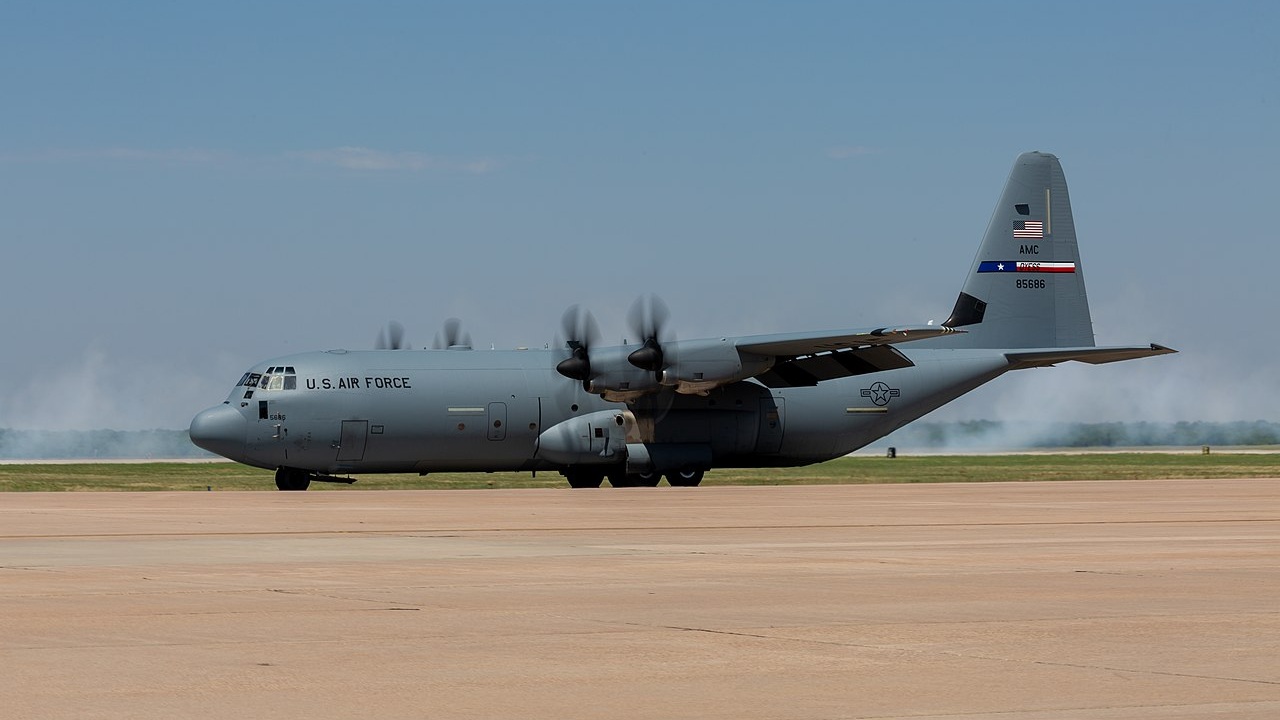
3. C-130 Hercules (Cargo Plane)
Introduced: 1956 (USA)
Operators: United States, Australia, India, Japan, and dozens more
- Year Introduced: 1956
- Number Built: ≈2,600+ (ongoing production as C-130J)
- Length: 97 ft 9 in (29.8 m)
- Wingspan: 132 ft 7 in (40.4 m)
- Weight (MTOW): ≈155,000 lb (70,300 kg)
- Engines: Four Allison T56-A-15 turboprops (~4,600 shp each), or Rolls-Royce AE 2100D3 on C-130J model
- Top Speed: ≈368 mph (592 km/h)
- Range: ≈2,360 nmi (2,716 mi, 4,370 km); can be extended with aerial refueling
- Service Ceiling: ≈33,000 ft (10,000 m)
- Loadout: Up to 92 troops, 64 paratroopers, or 42,000 lb (19,050 kg) cargo; numerous special mission kits
- Aircrew: 5 (pilot, co-pilot, navigator, flight engineer, loadmaster)
The C-130 remains the gold standard for tactical military airlift. From troop transport and cargo drops to medical evacuation, firefighting and gunship roles, the C-130 has performed most of the tasks an aircraft can perform.
The modern C-130J “Super Hercules” features digital avionics and more powerful engines, ensuring that production and service will extend into the 2040s. The C-130’s combination of reliability, rugged design, and adaptability make it a legend of continuous service.
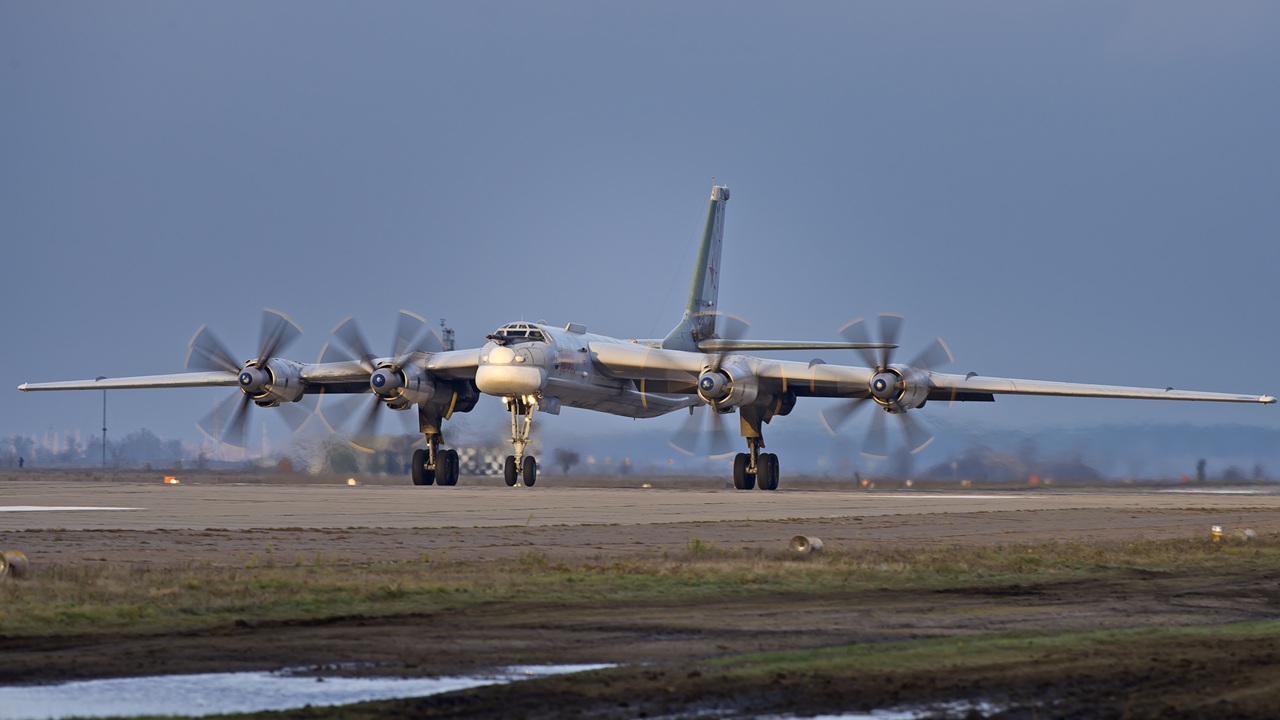
2. Tu-95 “Bear” (Bomber)
Introduced: 1956 (USSR)
Operators: Russia
- Year Introduced: 1956
- Number Built: ≈500 (all variants)
- Length: ≈154 ft (46.2 m)
- Wingspan: ≈167 ft (50.9 m)
- Weight (MTOW): ≈410,000 lb (185,000 kg)
- Engines: Four Kuznetsov NK-12MP turboprops with contra-rotating propellers (~15,000 shp each)
- Top Speed: ≈575 mph (925 km/h)
- Range:
- ≈4,300 nmi (4,948 mi, 8,000 km) unrefueled
- ≈8,100 nmi (9,321 mi, 15,000 km) with aerial refueling
- Service Ceiling: ≈45,000 ft (13,700 m)
- Loadout: Up to ≈30,000 lb (13,607 kg) of bombs or 6–16 cruise missiles (Kh-55 / Kh-101 series) depending on variant
- Aircrew: Typically 7 (pilot, co-pilot, navigator, flight engineer, radio operator, tail gunner, additional mission specialist depending on variant)
The Tu-95 is one of the most recognizable and longest-serving strategic bombers in history. Its swept wings and massive contra-rotating turboprops give it a distinctive look and sound. Designed during the Cold War to deliver nuclear weapons across intercontinental ranges, the Tu-95 has remained in service for nearly seven decades thanks to continuous modernization. The platform’s ability to cruise efficiently at high subsonic speeds, combined with its enormous range, has kept it operational even in the age of stealth bombers and hypersonic missiles.
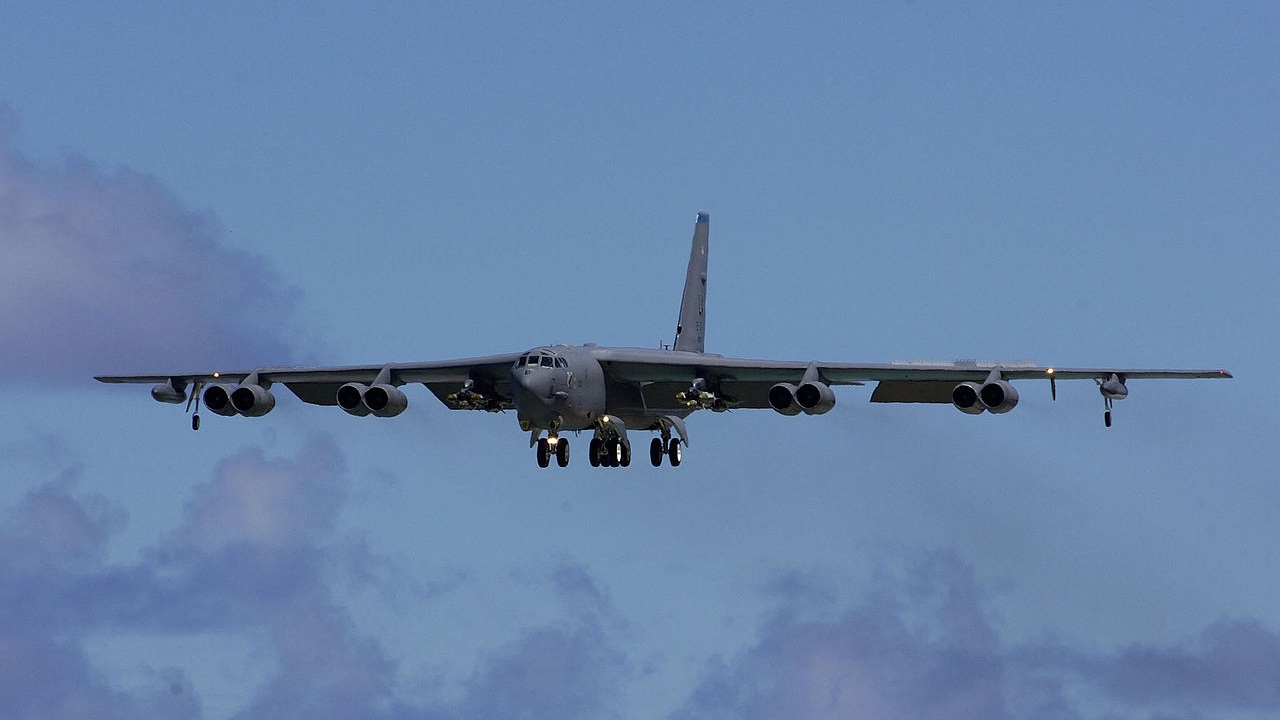
1. B-52 Stratofortress (Bomber)
Introduced: 1955 (USA)
Operators: United States
- Year Introduced: 1955
- Number Built: 744 (≈70 active B-52H models)
- Length: 159 ft 4 in (48.5 m)
- Wingspan: 185 ft (56.4 m)
- Weight (MTOW): ≈488,000 lb (221,000 kg)
- Engines: Eight TF33-P-3/103 turbofans (~17,000 lbf each; to be re-engined with RR F130)
- Top Speed: ≈650 mph (1,046 km/h)
- Range: ≈8,800 mi (10,126 mi, 14,160 km)
- Service Ceiling: ≈50,000 ft (15,200 m)
- Loadout: ≈70,000 lb (31,751 kg) of bombs, cruise missiles, and mines (nuclear or conventional)
- Aircrew: 5 (pilot, co-pilot, navigator, radar navigator, electronic warfare officer)
The B-52 has outlived every aircraft intended to replace it. With an enormous payload, long range, and nimble adaptability, the B-52 has been the US Air Force’s workhorse bomber since the Eisenhower administration.
Constantly modernized, with new radar, avionics, and engines, the “BUFF” is expected to serve at least into the 2050s—completing an unprecedented 100 years of operational life.
About the Author: Harrison Kass
Harrison Kass is a senior defense and national security writer at The National Interest. Kass is an attorney and former political candidate who joined the US Air Force as a pilot trainee before being medically discharged. He focuses on military strategy, aerospace, and global security affairs. He holds a JD from the University of Oregon and a master’s in Global Journalism and International Relations from NYU.
Image: Wikimedia Commons.


















.jpg)