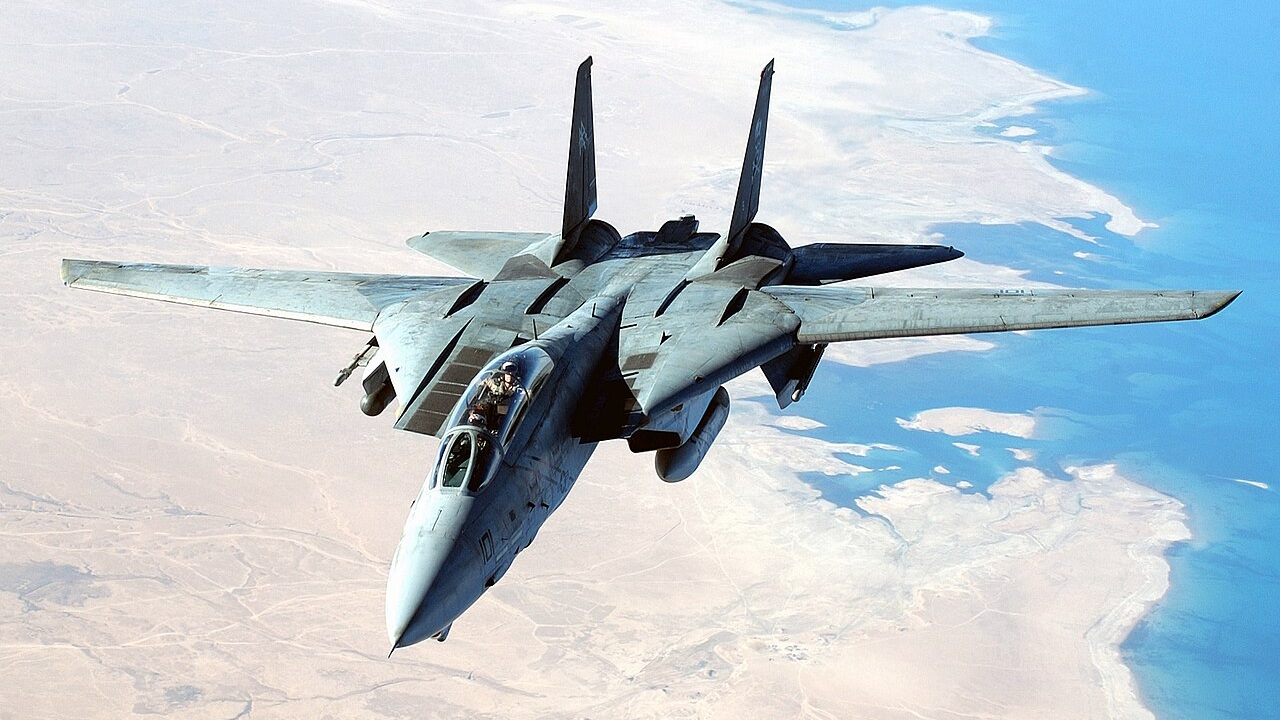
The functions that the US Navy built the F-14 Tomcat for—aerial interception of Soviet fighter jets—became irrelevant after the Cold War ended.
Most people know the F-14 Tomcat as a Cold War interceptor—famous for its star turn in Top Gun, where Tom Cruise and Val Kilmer piloted the swept wing, twin-tailed dogfighters. That portrayal was accurate, at least for its time. But it is a snapshot of the F-14’s earlier use, which failed to anticipate that the F-14’s most consequential combat use wouldn’t come against the Warsaw Pact—and it wouldn’t come as an interceptor. Instead, in the early 21st century, the F-14 was deployed to the deserts and mountains of the Middle East, where the once-interceptor was deployed as a multirole strike and close air support platform, performing admirably in roles that it was never designed for.
The F-14 Tomcat’s Specifications
- Year Introduced: 1974
- Number Built: 712 (all variants)
- Length: ≈62.8 ft (19.1 m)
- Wingspan: 64 ft (19.5 m) unswept / 38 ft (11.6 m) swept
- Weight (MTOW): ≈74,350 lb (33,720 kg)
- Engines: Two Pratt & Whitney TF30 (early) or GE F110-GE-400 (later) afterburning turbofans
- Top Speed: ≈1,544 mph (2,485 km/h) / Mach 2.34
- Range: ≈1,600 nmi (1,841 mi, 3,000 km) ferry; ≈500+ nmi combat radius
- Service Ceiling: ≈53,000 ft (16,150 m)
- Avionics: AN/AWG-9 or AN/APG-71 radar; LANTIRN targeting pod (late B/D)
- Loadout: AIM-54 Phoenix, AIM-7 Sparrow, AIM-9 Sidewinder, JDAM, LGBs, Mk-80 series, occasional JSOW; 20mm M61 Vulcan cannon
- Aircrew: 2 (pilot + radar intercept officer)
The Tomcat’s Post-Cold War Turn
The F-14’s transformation began in the 1990s, after the Soviet Union had collapsed and the US defense budget constricted. The US Navy, confronted with resource scarcity and mission evolution in the post-Cold War drawdown, sought to extract more versatility from their existing F-14 fleet.
While the F/A-18 Hornet, still relatively new to the fleet, did offer a versatile lightweight multirole option, the jet lacked the range, payload, and two-crew configuration that had made the F-14 so valuable as an interceptor. The Navy recognized the inherent abilities of their long-range interceptor, seeing a latent bomber that just needed a few modernizations.
Through successive upgrades, including digital flight controls, structural reinforcement, and the integration of the AN/AAQ-25 LANTIRN targeting pod, the F-14 was modified into a precision strike and night-attack capable aircraft. And by adding JDAM and laser-guided munitions to an aircraft that already had impressive range, loitering ability, and payload capacity, the Navy effectively created a long-range strike aircraft that was superior to the multirole F/A-18 in certain respects.
The F-14’s Eventful Post-9/11 Life
The newly transformed F-14 was tested in combat after the September 11 attacks. During Operation Enduring Freedom in Afghanistan, the F-14 flew from carriers in the northern Arabian Sea and used aerial refueling to reach landlocked battlefields hundreds of miles inland. The mission set included precision bombing, on-call close air support, forward air controller work, and real-time surveillance using LANTIRN’s infrared imagery. The two-person crew allowed for a manageable workload across the long-range and complex missions; the pilot flew the plane, of course, handling terrain and refueling and threat awareness, while the radar intercept officer (RIO) handled video, ground coordination, and targeting duties. The F-14 proved valuable in the mountain regions of Afghanistan, where US troops often operated in small numbers in poor visibility—and needed support that could, first, reach them, second, loiter, and last, provide precision strike.
The F-14 also served in Operation Iraqi Freedom, again performing precision strike, reconnaissance, and close air support missions. Equipped with JDAMS, GBU-12s, and occasionally AGM-154 JSOW glide weapons, the F-14 hit leadership compounds, radar sites, airfields, and armored formations—all remarkable applications for an aircraft that had been designed solely to intercept Soviet bombers.
However, despite the F-14’s 21st century success, retirement was inevitable. The aircraft was very expensive to maintain; its complex variable-geometry wings, aging airframe, and 1970s-era infrastructure all required intensive maintenance hours after each flight. Spare parts also became increasingly difficult to source; corrosion was a persistent issue; and the Navy wanted to consolidate around a single multirole platform—the F/A-18E/F Super Hornet.
The F-14 was retired in 2006, having proven itself capable of excellence beyond its design envelope.
About the Author: Harrison Kass
Harrison Kass is a senior defense and national security writer at The National Interest. Kass is an attorney and former political candidate who joined the US Air Force as a pilot trainee before being medically discharged. He focuses on military strategy, aerospace, and global security affairs. He holds a JD from the University of Oregon and a master’s in Global Journalism and International Relations from NYU.
Image: Wikimedia Commons.