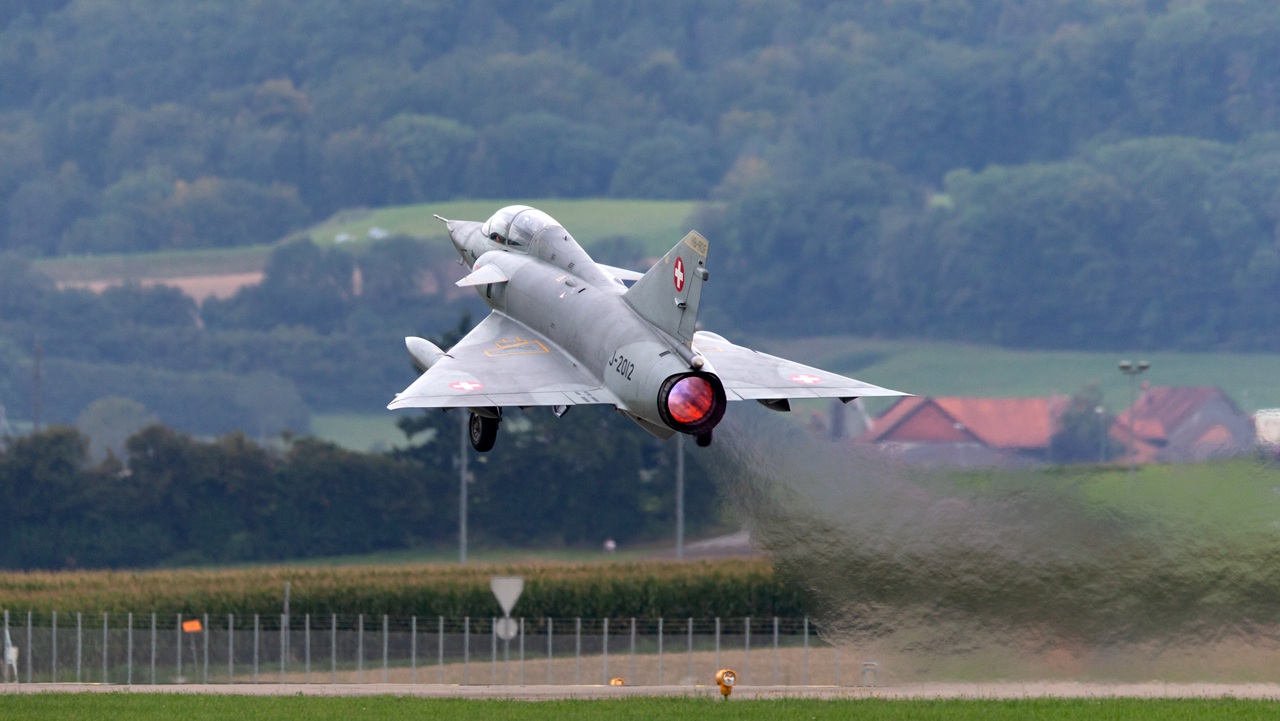
The Mirage III’s simple and effective design, centered around a delta wing and powerful turbojet engine, has given it remarkable longevity.
The introduction of the Dassault Mirage III in 1961 marked a transformative moment for the French aerospace industry. When the aircraft first entered service, it was a significant technological leap: a tailless delta-wing interceptor capable of sustained Mach 2 speeds, a feat only the Americans and the Soviets had previously accomplished. For France, a nation still emerging from postwar reconstruction and reeling from geopolitical setbacks in Indochina and Algeria, the Mirage III signaled not just an engineering triumph but a strategic return to relevance—giving France an indigenous air-superiority platform at a time when Paris was determined to carve out an independent defense posture.
The Mirage III’s Specifications
- Year Introduced: 1961
- Number Built: ≈1,400
- Length: ≈49 ft (15 m)
- Wingspan: ≈27 ft (8.2 m)
- Weight (MTOW): ≈30,900 lb (14,000 kg)
- Engine: One SNECMA Atar 09C turbojet (~13,700 lbf thrust w/ afterburner)
- Top Speed: ≈1,450 mph (2,335 km/h) / Mach 2.2
- Range: ≈740 nmi (851 mi, 1,370 km)
- Service Ceiling: ≈55,000 ft (16,800 m)
- Loadout: Two 30mm DEFA cannons; up to 8,000 lb (3,600 kg) of missiles and bombs
- Aircrew: 1
Dassault’s Design Philosophy: Keep It Simple
The Mirage III’s design philosophy was clean and efficient. The firm’s engineers opted for a pure delta wing, which offered low drag at high speeds, excellent climb performance, and structural simplicity. Powered by a single SNECMA Atar 09B turbojet engine, the Mirage III could reach speeds of approximately Mach 2.2, making it one of the fastest European fighters of its era. The aircraft’s Cyrano radar and ability to fire Matra air-to-air missiles gave the French Air Force a credible interceptor for defending national airspace. Later Mirage variants, like the IIIC and IIIE, incorporated improved avionics, greater fuel capacity, and multirole capabilities—transforming the jet from a point-defense interceptor into a flexible workhorse capable of ground attack and recon.
Where the Mirage III truly left its mark was on the global market. At a time when most of the world’s air forces were dependent on either US or Soviet exports, Dassault offered a rare alternative, a modern fighter that was politically accessible, technically capable, and relatively affordable. As a result, the Mirage III became one of the most widely exported Western fighters of the Cold War. Suitors included Argentina, Australia, South Africa, Switzerland, Pakistan, Brazil, Lebanon, and Spain. Israel used the Mirage III as the primary air-superiority fighter during important conflicts; Israeli Mirage IIIs scored air-to-air wins during the Six Day War and the War of Attrition, earning a reputation as a capable dogfighter with slick acceleration and powerful climb performance. The credibility Dassault gained from the Mirage III’s combat performance paved the way for the Mirage 5, Mirage F1, and ultimately, the Rafale.
The Mirage III Is Still Flying—in One Unlikely Place
Despite being a sixty-year-old platform, the Mirage III is still operational, albeit on a limited scope. Pakistan is the last remaining major operator, flying upgraded Mirage IIIs and Mirage 5s as part of a strike and recon inventory. Argentina also flew the Mirage III well into the 20th century, only recently retiring the Cold War platform.
Of course, the Mirage III is no longer relevant in terms of modern air competition; the platform has been out of date for decades, retired from front-line service in the air forces of the major world powers. But the Mirage III’s legacy endures in the DNA of subsequent Dassault fighters. And the Mirage III’s combination of speed, simplicity, export viability, and combat credibility make it an enduring symbol of Cold War air power—a rare example that originated neither from American nor Soviet industry. Today, the Rafale occupies a similar place in world aviation—an attractive third-party export option balanced between East and West, derivative in spirit from the Mirage III.
About the Author: Harrison Kass
Harrison Kass is a senior defense and national security writer at The National Interest. Kass is an attorney and former political candidate who joined the US Air Force as a pilot trainee before being medically discharged. He focuses on military strategy, aerospace, and global security affairs. He holds a JD from the University of Oregon and a master’s in Global Journalism and International Relations from NYU.
Image Shutterstock / Ryan Fletcher.