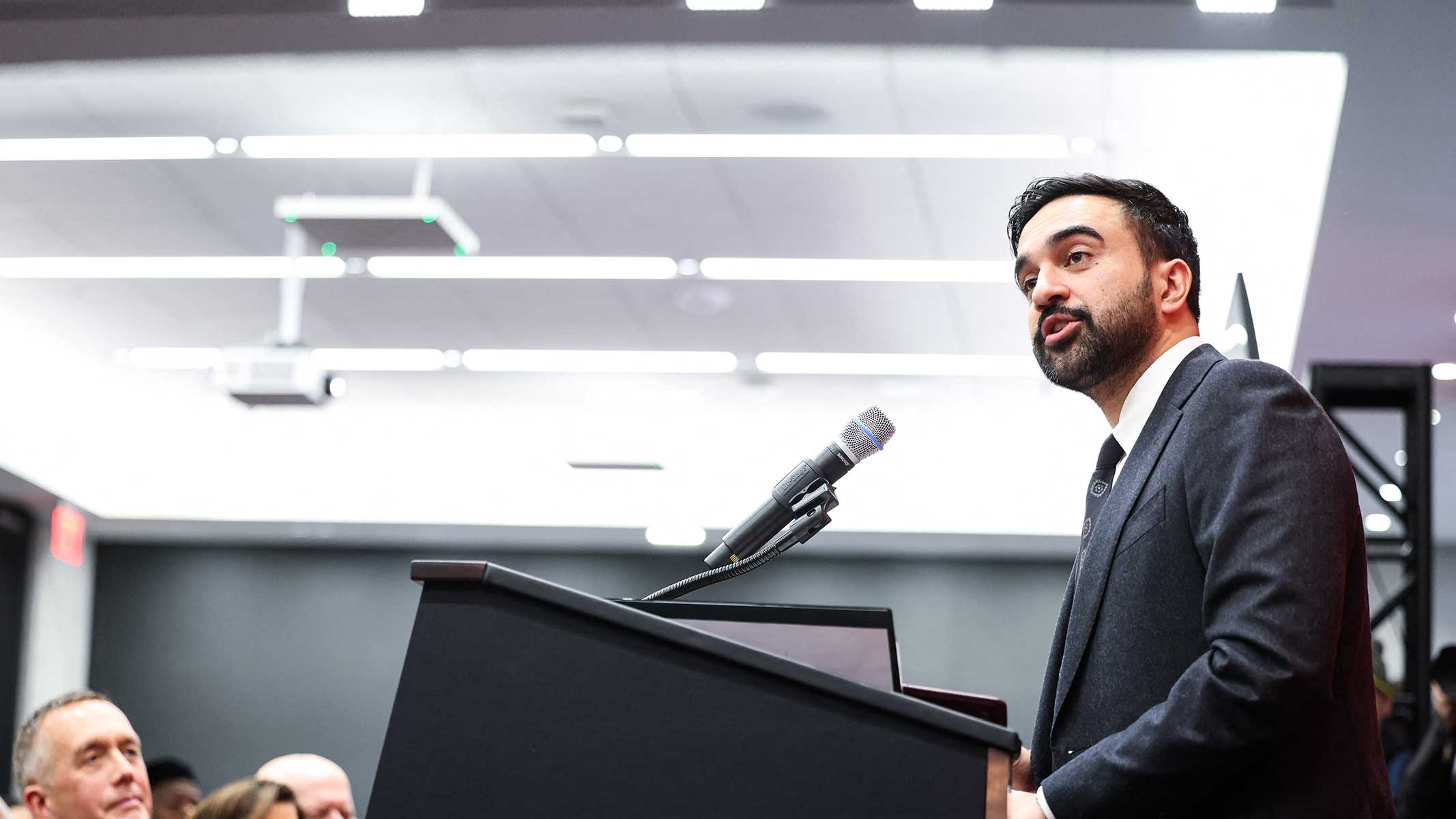
The election of Zohran Mamdani as mayor of New York represents a seismic victory for the Democratic Socialists of America. Yet even as the DSA seems poised for a political breakthrough, it shows signs of unraveling.
Indeed, even before Mamdani’s victory last week, DSA members were intensely divided over whether his election would represent an electoral success or capitulation to the status quo. Some on the party’s radical fringes have argued against a consensus document meant to define DSA’s positions on Mamdani’s campaign. These tensions could shape Mamdani’s mayoralty and the future of socialist politics in America.
Finally, a reason to check your email.
Sign up for our free newsletter today.
The DSA is not a political party. Like a party, however, the DSA has several factions and caucuses that jockey for power. Many of the DSA’s most prominent members belong to the Groundwork caucus, which emphasizes political reform and the need to preserve strong relationships with mainstream progressives and Democrats. These members are typically influential in the group’s politics.
But Groundwork often struggles to corral the DSA’s more radical wings. Groundwork representatives could not, for example, convince the rest of the DSA’s National Political Committee to endorse the No Kings Day protests.
These tensions mounted a week before the October 2025 meeting of New York City DSA, when the city chapter’s steering committee introduced two propositions: “Local Dues Drives Proposal” and “NYC-DSA Goals in Electing a Democratic Socialist Mayor.” While both documents provoked debate, conflicts flared in particular over one line in the second document: “If we succeed in electing Zohran Mamdani, our priorities will be campaigning for a democratic socialist mayor, expanding working-class power, and winning material improvements in the lives of the working class.” (NYC DSA did not respond to a request for comment for this article.)
Some members of NYC DSA and other chapters across the country feared this language would make Mamdani’s candidacy too central to the organization’s mission. Within days, five DSA factions—Springs of Revolution, Emerge Caucus, Libertarian Socialists, Reform and Revolution, and Marxist Unity Group (MUG)—published a flyer encouraging members to vote “No” on both propositions. They also released a petition demanding that the city chapter hold a “special meeting” in January with “true deliberative spaces, where members can collectively decide our work.”
There’s reason to suspect that one of those factions, MUG, has long been wary of Mamdani’s run for mayor. In August 2024, two months before Mamdani launched his campaign, someone writing under the name “Sid C.”—possibly Sidney Carlson White, a MUG member who now sits on DSA’s National Political Committee—penned a piece in the Socialist Tribune (a MUG-run Substack newsletter) arguing that it was “imperative that Zohran Mamdani . . . NOT run to win.” (a comment request to the newsletter’s email went unanswered.)
Instead, Sid C. argued, Mamdani should run an “agitational campaign” that advances the DSA’s positions on issues ranging from Palestine to police abolition in hopes of “lay[ing] the groundwork for our socialist future.”
Mamdani’s victory in the Democratic primary sent MUG back to the drawing board. In September, the entire faction published a missive that outlined its strategy for the “Mamdani moment.” The document demanded more “democratic” DSA institutions, with more “transparency and accountability” from the group’s leadership. It also outlined several principles about the DSA’s relationship to Mamdani, including asserting that “Zohran should be accountable to DSA’s democracy.”
The Liberation Caucus also opposed the pro-Mamdani propositions. Calling itself “Marxist-Leninist-Maoist,” the group formed this year to advocate for more revolutionary politics within the organization. Liberation Caucus recently issued its own response to the propositions, denouncing the NYC DSA for “seek[ing] to turn an ostensibly socialist organization into an electoral cheerleading and fundraising machine.”
“What worker would donate to NYC-DSA,” the group asked, “if all we do is run electoral campaigns?”
Remarkably, some of the Liberation Caucus’s members believe that Mamdani has become too conservative and friendly to Israel. One member called Mamdani “ZIOhran” and accused him of “pivot[ing] further and further to the right.” Another deemed Mamdani a “traitor and an opportunist,” adding, “[I w]ould not vote for him if I [were] a New Yorker.”
While some in the DSA’s radical fringes think that Mamdani is too mainstream, others see the mayor-elect as a revolutionary. In Partisan, a Communist magazine, someone writing under the name “Landry L.” argued that Mamdani’s mayoral campaign gave socialists an opportunity to “unite new and existing fights under a common banner.”
Mamdani’s campaign presents “a golden chance . . . to build power both inside and outside the state,” Landry L. writes. Invoking historian Noel Ignatiev—known for his calls to abolish “whiteness” and his objections to kosher toasters—Landry L. suggests that DSA and its allies should “actually instigate [a crisis] by deepening the contradictions in the current political order.” Even if Mamdani fails to deliver on his agenda, Landry L. argues, “his position as mayor will open possibilities that are bigger than a single mayoral administration in one city.”
These disputes reveal the extent to which Mamdani’s DSA coalition is fractured. His ideological allies cannot agree on the purpose of his mayoralty, or even whether it’s worthwhile. Is the mayor-elect merely an “organizer in chief,” or does he have the “radical potential” to spark a crisis that ushers in a socialist revolution? As the DSA takes power, New Yorkers should pay close attention to the answers.
Photo by CHARLY TRIBALLEAU/AFP via Getty Images
City Journal is a publication of the Manhattan Institute for Policy Research (MI), a leading free-market think tank. Are you interested in supporting the magazine? As a 501(c)(3) nonprofit, donations in support of MI and City Journal are fully tax-deductible as provided by law (EIN #13-2912529).
Source link