The HIMARS multiple rocket launcher is one of the world’s most demanded military platforms, due in large part to its tremendous battlefield success in Ukraine.
Defense giant Lockheed Martin announced this week that it had delivered the 750th M142 High-Mobility Artillery Rocket System (HIMARS) multiple rocket launcher (MRL) to the United States Army. The “shoot-and-scoot” weapon system, first introduced in the early 1990s, offers high mobility, a key factor in its success in Ukraine.
It remains a key platform in the US Army’s “Long-Range Precision Fires (LRPF) strategy,” while the HIMARS has also been adopted by more than a dozen allies and partners around the globe.
“HIMARS embodies what modern fires demand—reliability, accuracy and survivability,” said Carolyn Orzechowski, vice president, Lockheed Martin Precision Fires Launchers and Missiles. “It shows what American industry can achieve when we innovate in lockstep with the US Army’s needs.”
Lockheed Martin Is Increasing HIMARS Production
The HIMARS has been a success story in multiple ways. Whereas multiple military programs are now running behind schedule with deliveries delayed, sometimes by years, that hasn’t been the case with the M142 HIMARS.
Lockheed Martin was able to double its annual production output at its Camden, Arkansas, facility, from 48 to 96 units, in support of a $2.9 billion contract that involved new tooling and the addition of workstations to streamline the manufacturing line. The defense firm reached the production goal two months early by increasing “throughput while preserving quality.” It has been the result of collaboration between the government and industry partners, which has kept the supply chain moving and ensured that the supply will meet the increased demand.
“Speed matters—not just in the field but on the factory floor,” explained Adam Bailey, Lockheed Martin Camden site director. “By streamlining processes and empowering our workforce, we’re getting capability into the hands of those who need it most.”
The Highland Industrial Park was established in Camden in the late 1970s as the home of Lockheed Martin’s Multiple Launch Rocket System (MLRS) production program. It now includes a “combined manufacturing and support function floor space” with more than 2.2 million square feet in total spread out across 2,400 acres of land. The workforce comprises 1,000 employees, including skilled machinists, assemblers, and engineers.
“Every bolt, wire, and weld connects our workforce here in the U.S. to soldiers and allies overseas,” added Bailey. “What we build in Arkansas makes a difference worldwide.”
The US Military Loves the HIMARS
It isn’t just the United States Army that continues to employ the HIMARS. It is worth remembering that the MRL platform was initially intended for use by US Army airborne troops and United States Marines to provide a 24-hour, all-weather, lethal, close- and long-range precision rocket and missile fire support for joint forces, early-entry expeditionary forces, contingency forces, and field artillery brigades supporting Brigade Combat Teams.
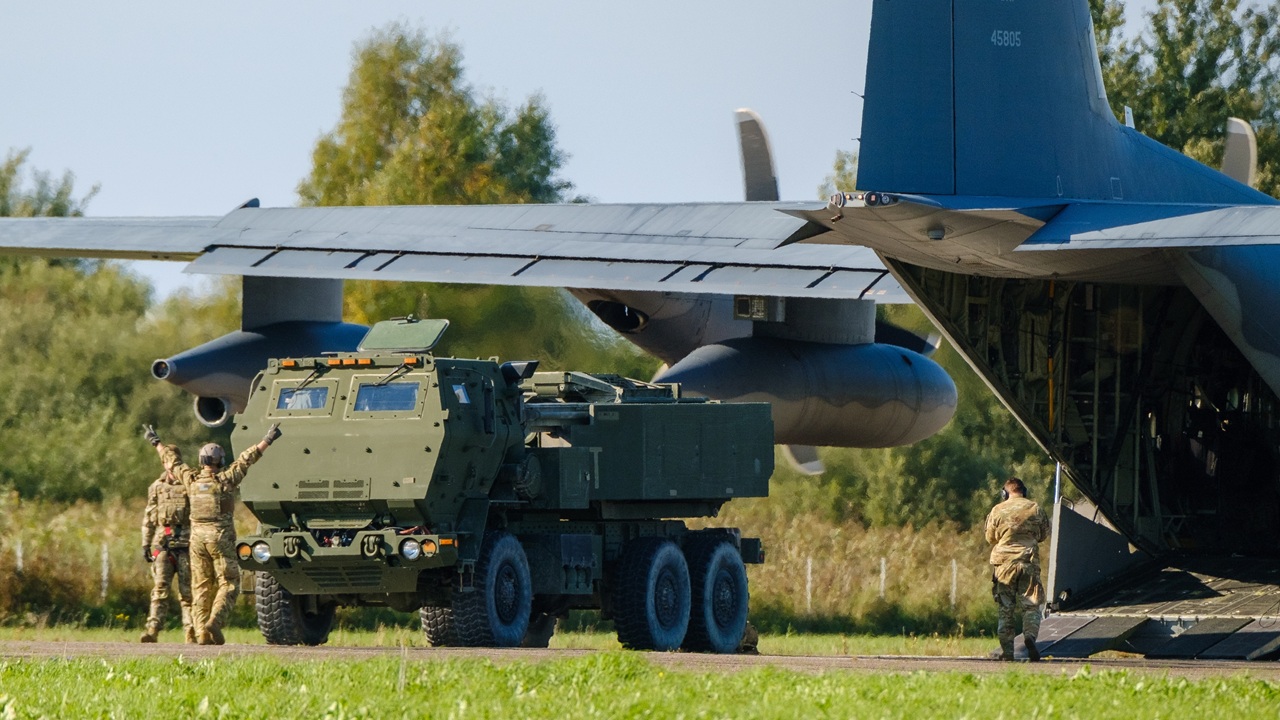
One of its key attributes is that the HIMARS is mounted on the five-ton family of Medium Tactical Vehicles, specifically the XM1140A1 truck chassis, which can be airlifted via a C-130 aircraft.
This allows it to be deployed to remote locations as needed. Once in the field, the entire system is operated by a crew of three, comprising a commander, driver, and gunner. Although the HIMARS includes an armored cab to protect the crew, the entire point of the system is that it won’t be around to receive an adversary’s counterfire.
Once it fires its load of six Guided MLRS (GMLRS)/MLRS rockets or one Army Tactical Missile System (ATACMS) missile, the HIMARS can quickly be on the move.
Just last month, the USMC conducted a “landmark training exercise” with the HIMARS at the base of Mount Fuji, Japan, Military Times reported. Units of the 3rd Battalion, 12th Marine Regiment, 3rd Marine Division, employed the HIMARS during a live-fire training exercise at Camp Fuji. It marked the first time the MLR system was employed at the base.
About the Author: Peter Suciu
Peter Suciu has contributed over 3,200 published pieces to more than four dozen magazines and websites over a 30-year career in journalism. He regularly writes about military hardware, firearms history, cybersecurity, politics, and international affairs. Peter is also a contributing writer for Forbes and Clearance Jobs. He is based in Michigan. You can follow him on Twitter: @PeterSuciu. You can email the author: [email protected].
Image: Shutterstock / Karlis Dambrans.