Recent air exercises at a Marine Corps base in Iwakuni, Japan, resulted in noise complaints from irate Japanese citizens—and even calls from government officials to end future training there.
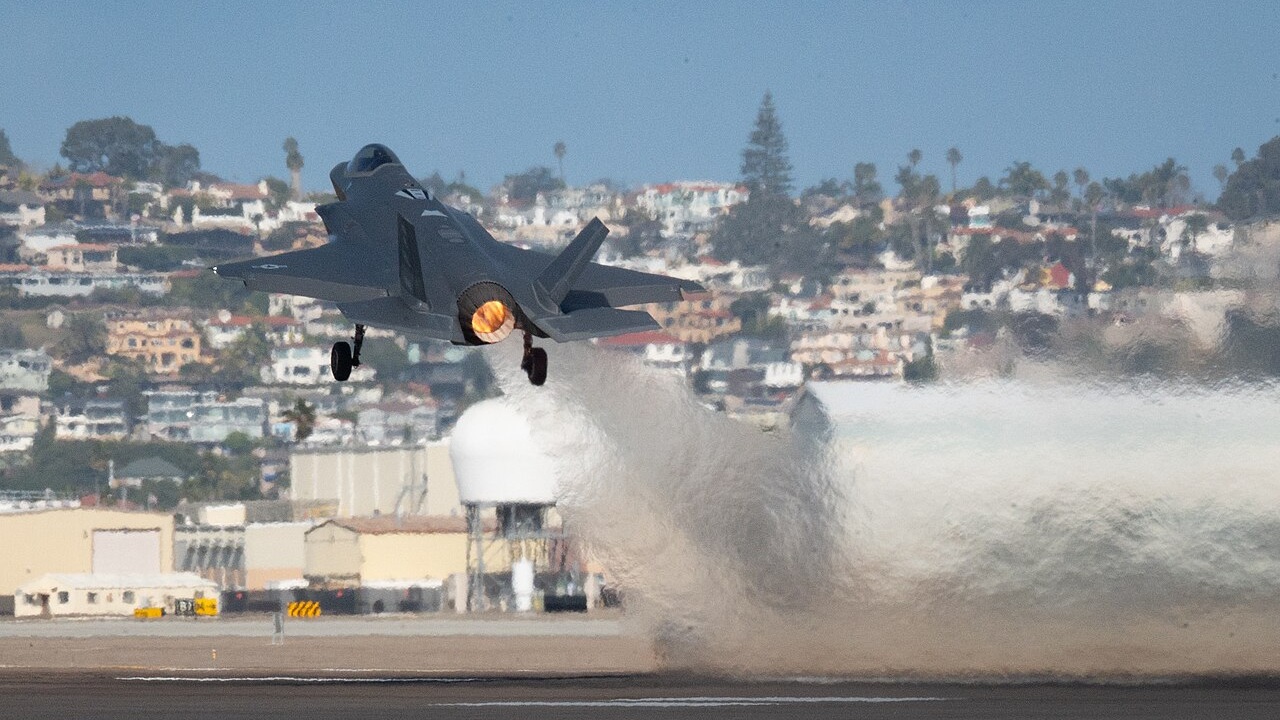
The Lockheed Martin F-35 Lightning II is a respected jet warplane, and with more than 1,100 now in service, it is not only the most successful fifth-generation stealth fighter in operation today, but one of the most widely adopted combat aircraft of the modern era.
However, the warplane has another, more dubious distinction: it is very, very loud. According to past studies, it is four times louder than the F-16 Fighting Falcon, which has raised concerns among those living near bases that operate the Lightning II.
American F-35s May Have Ruined a Local Holiday
The excessive volume has become a serious issue in Japan. This month, officials near the US Marine Corps Aviation Station Iwakuni in southern Honshu called for a ban on fixed-wing aircraft training as the George Washington Carrier Group’s air wing has been conducting its “pre-deployment training,” which coincided with a Japanese holiday.
According to a report from USNI News, Carrier Air Wing 5 (CVW-5), which will be embarked on the Nimitz-class nuclear-powered supercarrier USS George Washington (CVN-73), has been carrying out field carrier land practice (FCLP) at the base, including on the Autumnal Equinox Day, a national holiday in Japan. The exercises resulted in dozens of noise complaints from irate Japanese citizens—and even calls from government officials for the end of future training at Iwakuni.
“As a city that has repeatedly requested that the training be canceled, not only before the training but also during its implementation, we cannot help but feel deeply indignant,” a delegation, led by the Japanese Defense Minister, the Ministry of Foreign Affairs and the US Embassy in Japan, and including mayors from regional cities near the base, wrote in a formal statement. “In this regard, we ask that you take seriously the enormous burden that this FCLP has placed on the residents living near the base, and we urge the US side to ensure that an FCLP is never conducted at MCAS Iwakuni again, regardless of the reason, and to take all measures to ensure this.”
The delegation has said that residents are “burdened daily” by the F-35 and other aircraft training at MCAS Iwakuni, including operations “beyond the stipulated hours,” according to USNI News.
CVW-5 FCLP training was initially slated to take place on Iwo Jima, far away from the Japanese mainland, but it was relocated to Iwakuni due to volcanic activity. The US military has sought to adhere to requests, while reserving the right to adjust the dates and even times due to external factors, including aircraft availability and weather conditions.
Japanese Defense Minister Gen Nakatani had requested that the FCLP training be conducted on Iwo Jima, and the US has been monitoring the situation. Even as the threat of earthquakes has decreased, smoke continues to rise from the island’s volcano. Damage to the airbase will begin once all volcanic activity has ceased.
Japan’s F-35s Are Getting Noise Complaints, Too
The issue of noise isn’t limited to the US F-35C aircraft, the carrier-based models that have been operating at MCAS Iwakuni. Japan is the second-largest operator of the F-35 after the United States, and its program of record calls for it to receive 106 F-35A and 42 F-35B models. The F-35B will eventually be embarked on the Japan Maritime Self-Defense Force’s (JMSDF’s) two Izumo-class multipurpose helicopter destroyers, which have been converted to operate with the short takeoff and vertical landing (STOVL) fighters. Following the conversion, the warships will serve as Japan’s first aircraft carriers since World War II.
F-35B STOVL flight training began at Nyutabaru Airbase on the southern home island of Kyushu in early August. That also led to concerns over noise levels, as the training was to include as many as 100 vertical landings carried out monthly—including dozens at night. Each landing is expected to last around three minutes. However, these landings produce around 110 decibels, roughly the noise of a chainsaw or leaf blower, at 300 meters, and upwards of 130 decibels from 75 meters.
In addition to conducting flight training on Iwo Jima, the Japan Air Self-Defense Force (JASDF) has sought to carry out future FCLP training on the remote Magashima Island, located approximately 30 miles south of Kyushu. The facility was supposed to be operational by 2027, but construction on the future airbase has been delayed due to labor and material shortages.
The current timeline calls for completion in 2030. Until then, a compromise between readiness training and noise concerns will need to be reached.
F-35s have caused other troubles for Japan, too. In August, a British F-35B Lightning, operating from the aircraft carrier HMS Prince of Wales, was diverted to Kagoshima Airport in Kirishima City in the Kagoshima Prefecture on Kyushu, shutting down a runway for about 20 minutes while the fighter was moved to a taxiway.
Japanese officials also filed a protest in May after a US Air Force B-1B Lancer was forced to make an emergency landing on a shared runway at Misawa Air Base in the Aomori prefecture, north of Japan’s main island of Honshu. That shut down air traffic for more than an hour and caused a commercial flight to return to Tokyo.
About the Author: Peter Suciu
Peter Suciu has contributed over 3,200 published pieces to more than four dozen magazines and websites over a 30-year career in journalism. He regularly writes about military hardware, firearms history, cybersecurity, politics, and international affairs. Peter is also a contributing writer for Forbes and Clearance Jobs. He is based in Michigan. You can follow him on Twitter: @PeterSuciu. You can email the author: [email protected].
Image: Wikimedia Commons.