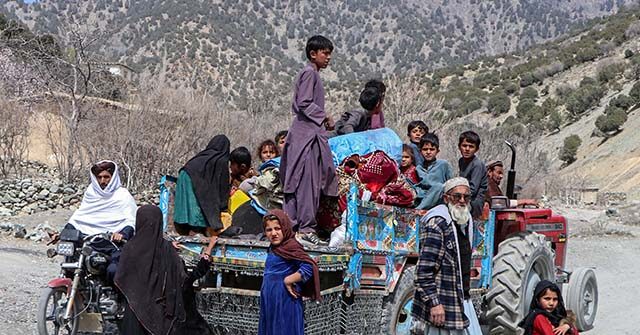
The U.N. said on Friday that over 100,000 people have been displaced by fighting between Afghanistan and Pakistan, which has been running at a tempo close to open warfare for the past week with no end in sight.
The Office of the United Nations High Commissioner for Refugees (UNHCR) begged Afghanistan and Pakistan to cease hostilities and turn their attention to resolving the humanitarian crisis created by their cross-border clashes.
The U.N. agency said the displacements were especially severe on the Afghan side of the border, where at least 56 civilians have been killed – including 24 children and 6 women – and up to 66,000 people have been driven from their homes. The Pakistani government rejected these figures and claimed it has not killed any Afghan civilians.
“Civilians on both sides of the border are now having to flee from airstrikes, heavy artillery fire, mortar shelling and gunfire. I plead with all parties to bring an end to the conflict, and to prioritise helping those experiencing extreme hardship,” said U.N. human rights chief Volker Turk.
UNHCR said the situation was harder on the Afghan side of the border because Pakistan began an “illegal foreigners repatriation plan” in September 2023 that deported over two million Afghans living in Pakistan. Another two million Afghan nationals are believed to remain in Pakistan, “where many face hardship and constant fear of arrest and deportation.”
“As a result of the violence, humanitarian assistance is unable to reach many of those desperately in need. This is piling misery on misery,” Turk said, noting that nearly half of Afghanistan’s population requires humanitarian aid after five years of misrule by the Taliban junta.
“The cycle of retaliation and violence only deepens the suffering of the wider population. I urge both Afghanistan and Pakistan to de-escalate and address the security issues they each face through dialogue, negotiation and mutual cooperation,” Turk said.
Afghan and Pakistani forces have been fighting sporadically since the Taliban returned to power in 2021, and swiftly antagonized its former supporters in Pakistan by refusing to crack down on militants who wanted to overthrow the government in Islamabad.
Pakistan’s ire was further piqued by the Taliban junta cultivating a friendship with Pakistan’s great regional rival, India. The Taliban, in turn, accused Pakistan of supporting insurgents in Afghanistan who want to overthrow the regime in Kabul.
The conflict went hot last week as Pakistan’s defense minister declared his government had lost “patience” with the Taliban, and a state of “open war” now existed.
The war continued on Friday with dozens of firefights reported along the border. As during previous clashes, each side claimed to have inflicted heavier casualties on the other.
Pakistan also said it conducted airstrikes against Kandahar, the city where much of the Taliban’s top leadership lives, and destroyed 14 Taliban border posts. Pakistan also claimed it shot down a Taliban drone.
The Taliban defense ministry claimed it attacked a Pakistani military base in the southwestern Balochistan province. Civilians on both sides of the border said they have been driven away from their homes by artillery fire.
Mosharraf Zaidi, a spokesman for the Pakistani government, said there are no talks underway to pause or end the conflict.
“There is nothing to talk about. There will be no dialogue, and no negotiations. Terrorism from Afghanistan has to end. That is Afghanistan’s problem. Pakistan’s responsibility is to protect its citizens,” he said.